Categories
Mythical Realms Vienna Treaty Wars wargaming

Fauxterre 1816 Part 4 – The Battle of Kloster Arens

19th March 1816 somewhere in western Zarland.

After the clash of advance guards it was now the turn of the Zarland and VinAlban main bodies to seek to control the River Hase.

The River Hase passes the Kloster Arens on its eastern bank ridge while on the west bank is the Arensburg and its no less imposing Rittergut.

The Royal Zarland Army was commanded by General Kratzen an above average General whose chief of staff General Klettern was in fact an outstanding Officer.

As dawn breaks the Zarland pickets see movement on the west bank of the River Hase
General Sumpf has elected to hold what he has – Kloster Arens and keeps his few forces east of the River Hase

The VinAlban army was commanded by General Geflugel (an average general) who had been delayed along the route of the march. General Modistin commanded the Davarian force sent to support Prince Otto’s latest attempt on his fathers crown. Modistin was a poor general and very much concerned with his own importance. General Geflugel had sent his Chief of Staff General Nelke (an above average commander) to meet Modistin and try to contain the unreliable General until he could arrive.

Both Zarland and VinAlban forces descend into the river valley
The Davarians are on the right flank, south of Kloster Arens and in force

The VinAlban and Zarland commanders had broken up their main bodies so as to push on to support their advance guards.

General Klettern had arrived with

  • 7th Cavalry
  • 5th Artillery

He sent these north west beyond Kloster Arens as it appeared the enemy were massing to cross the river Hase. General Sumpf had also mentioned the defeated VinAlbans had retreated north the previous evening – no doubt back onto their main body?

General Nelke had likewise brought some troops to reinforce the advance guard of General Stute. He had

  • 10th Infantry battalion
  • 2nd and 3rd Artillery
  • 4th Cavalry
  • 11th Skirmishers

General Nelke dispatched General Stute north with part of this force as reports had been received of enemy movements from that direction.

He then pushed a force across the river Hase in readiness for the arrival of General Geflugel and the main body. Its orders were to secure the flat ground north of Kloster Arens.

The force comprised

  • 4th Cavalry
  • 12th Infantry
  • 10th Infantry
  • 3rd Artillery

He then rode to meet General Modistin who had already arrived from the south west with a substantial force of Davarian troops.

both sides are bold with their artillery!

Earlier at 0400 am General Sumpf again sent patrols north to check on the VinAlbans whose advance guard had withdrawn in that direction the previous day. The 19th of March had dawned very cloudy but still dry. General Kratzen would soon arrive with the main Royal Zarland army.

The forces gather their courage
It is the Davarians who are across the river first as the VinAlban 4th cavalry also begin their crossing

General Klettern had in fact arrived earlier to take over from General Sumpf who took some rest in the Kloster Arens. General Klettern had been surprised to see not just VinAlbans across the Hase river valley but Davarians. He had immediately sent a courier to General Kratzen to hasten forward.

Vin Albans cross north of Kloster Arens as the first attack is made directly by the Davarians on Kloster Arens itself. Ouch!
Today the artillery are seemingly ineffective
General Nelke watches as the assault on Kloster Arens develops
Vin Alban skirmishers and infantry take artillery hits as the Davarians attack across the old sawmill bridge to the south

On the west side of the valley General Modistin had arrived at the Rittergut, meeting General Nelke and immediately demanded to know where General Geflugel was.

General Modistin was noted as a poor General yet he had sent his forces straight into attack showing an unexpected degree of boldness. General Nelke viewed the developing frontal attack with dismay.

The combined VinAlban and Davarian forces had descended the valley and made for the Kloster Arens and its ridge.

Finally both sides begin to see the attrition build from firing exchanges
The Davarians are seemingly undeterred by the steepness of the Hase river valley sides

General Klettern spreads his weaker forces across the ridge to contain the advancing VinAlbans and Davarians, feeding in the main body troops as they arrive on the Kloster Arens road. General Kratzen is now at the Kloster Arens and discovers a General Sumpf slightly the worse for sampling some excellent Kloster wine. Even so General Kratzen is pleased with Sumpf’s work the previous day.

As the afternoon beckons the grey day turns darker under heavy rain clouds. The Zarland forces have crossed the river Hase north of the Kloster bridge while the 3rd artillery deployed at the bridge and luckily for them. Opposite the 2nd Zarland Artillery, an elite unit, are under orders not to fire on the bridge which must be taken intact!

Today the elite artillery are off colour anyway as they fail to get the range on the advancing VinAlban 10th Infantry.

The fordable river is no barrier to the advancing troops. But it is the persistent light rain that is now affecting events.

The 14th Davarian Infantry are driven back across the old sawmill bridge

As the 14th Davarian Infantry seek the ridge line to the south of Kloster Arens they meet the 14th Zarland Cavalry and are driven back across the river Hase – with few casualties but suitably shaken.

Meanwhile north of Kloster Arens the VinAlbans turn the Zarland flank. Is this the moment the position becomes untenable?

Attrition is working through all the units in the battle. In the far distance the VinAlbans outnumber the Zarland right wing

At 1800 hrs the heavens open and a mighty deluge of rain slows movement and impacts firing. Although the Vinalbans are now making progress General Geflugel decides to withdraw across the river Hase as the weather shows every sign of getting even worse.

Photo by JACK REDGATE on Pexels.com

And so the battle ends with the Zarland Royal Army still holding Kloster Arens.

That evening General Geflugel held a review with his senior commanders including a frustrated General Modistin, the Davarian General. Everyone was informed that there would be no resumption of the attack as new orders from VinAlba required a withdrawl from Zarland.

An incredulous General Modistin stormed out of the tent into the torrential rain. He mounted his soaking wet horse and rode away cursing VinAlba and her useless Generals. At least he could say he had shed Davarian blood for Prince Otto in the so called battle of Kloster Arens.

……………as darkness gathers at the Rittergut, under leaden skies, the thoroughly soaked General Modistin grabs the last spotlight by staring hard to the east at Kloster Arens………………..

Categories
Mythical Realms wargaming

Fauxterre: Campaigning without Maps

Surely Campaigning without maps is an oxymoron? and when it comes to wargaming, maps are central to what defines wargame campaigns as opposed to say, endless rounds of competition encounter battles.

Well thats true. I have spent most of my wargaming life pursuing the mantra that the greater the detailed map the more satisfying the campaign.

Or so I thought.

I guess there have been numerous nudges away from that point of view when I think about it.

The thing is that I have applied the same abstraction that works for the field of battle to campaign maps. Out go measured marches and in comes the dreaded “outcome”. I suppose the test for some might be “does the end justify the means?” or why waste time getting a result that does not improve your hobby enjoyment.

Except “process” is what a lot of wargaming is and that means the process is the enjoyment in itself.

Moving pieces across a map at steady rates, checking the weather, accounting for ground conditions and working out where the enemy is are themselves a process to get to that almighty battle outcome – ok 6 units a side armed with One Hour Wargames – because you must go shopping or rearrange the cushions on the settee this afternoon for an evening watching the football/that latest box set/a comedy (delete /insert as appropriate).

It is not all about “outcomes ” because you could complete the abstraction and just toss a coin to find out who won that 5 year campaign you cannot seem to finish.

abstraction or the level of abstraction is often best considered in art – East Coast port image to be found in Hull Ferens Art Gallery.

It is about putting your effort into those parts of the process you most want to enjoy and sacrificing others through abstration to get you to those parts that matter.

And it is not that I don’t have any maps. I just use them in certain areas. I just don’t measure movement of forces “to scale” across them.

To my mind wargame rules came to the fore in the decades when scale paper maps became something to be purchased and valued – and used. People were taught eastings and northings and also how to fold a map. Remember some Generals fought their battles on the creases of the map in the pouring rain……..

Today you just flick the “app” tap a few virtual buttons and a high resolution image appears – is that my neighbours 3rd or 4th car – don’t remember it being that red – just how old is that image anyway…….sat navs beware……

For my Twins War in Fauxterre I have a narrative map.

High Res image of a low res campaign map!

Fauxterre is explained here:

https://wordpress.com/post/thewargamingerratic.home.blog/2061 .

https://upload.wikimedia.org/wikipedia/commons/d/df/QSH_Tin_Wind_Up_Astro-Scout_Doppelg%C3%A4nger_%28Journey_to_the_Far_Side_of_the_Sun%29_Movie_Homage_2.jpg
D J Shin, CC BY-SA 3.0 https://creativecommons.org/licenses/by-sa/3.0, via Wikimedia Commons

And I do have a means of moving forces in Fauxterre – it is an abstraction.

So here is the abstraction for my Twins War in Fauxterre.

looks familiar…………..

I guess at a certain point – by the late 1990’s? the DBA wargame rules offered the most popular version of this diagram.

well used and enjoyed
the last page

By version 3.0 campaigns had been quietly dropped from the title along with the diagram.

Except NO! – the diagram had been replaced by a set of words in the giant hardback tome that is now DBA post 2014: Maybe a case of more becoming less?

ok so you get colour and royal purple(maybe mauve?) but the simple diagram has been discarded in favour of words

I suspect this diagram had in the meantime launched tens of thousands of wargames campaigns – ok maybe thats a bit excessive!

Well that’s it for now, I will explore the mechanisms that allow me to abstract the mapping activity in a way that balances my available time, the process, the outcome and most of all the enjoyment of solo wargame campaigns.

I will finish with some words from Donald Featherstone which are surprising given they are to be found in his book War Game Campaigns.

quite a statement in a book devoted to campaigning wargames! the one about the real meat of the hobby NOT austrian armies rolling over……………

That is the challenge – making table top battles part of a narrative or simply having continuity requires effort. Effort which is not available for gaming the battles or painting the troops. Take your pick or choose your abstraction.

Categories
Mythical Realms wargaming

Mythical Realms

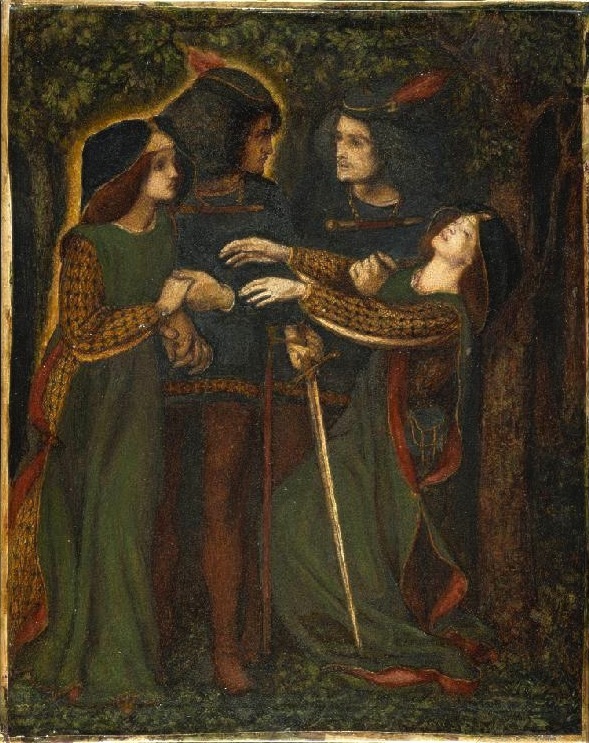
https://upload.wikimedia.org/wikipedia/commons/2/2d/Dante_Gabriel_Rossetti_-_How_They_Met_Themselves_%281860-64_circa%29.jpg
https://dantisamor.wordpress.com/2014/01/14/how-they-met-themselves-pre-raphaelitism-and-the-double/

What happens when you meet your doppelganger?

Actually it is best not to.

In my case – creating a Mythical Realm is not normally a problem because I tend to invent some totally separate location that just happens to have the same oxygen, societies, nature, science and warfare of the period I want to plunder.

And then occasionally real history just cries out to be used. Italy is a regular case in point for me. Most recently I was on a Normans in the South (NitS) splurge before crashing into Faux Napoleonics by Renaissance Troll.

One thing has led to another and one minute I was on the Wars of the Italian Unification (WotIU) – kepis, garibaldi and kettels, next I am thinking how to do Napoleonics without Napoleon, Wellington or Blucher etc.

Well I have solved the problem – it is a Vardoger Planet – ok maybe it is a sort of doppelganger.

The story is this.

Once upon a time there was a planet – called Earth and in front of it so to speak was another planet called Earth which experienced everything just that bit earlier. And so the worlds trundled along except that one day there was a small ripple and it was a very small ripple.

No one noticed because no one knew. Well I guess someone knew because I would not be telling you this.

We live on the first planet, or lead planet. The “Vardoger” one. Now our following planet is just slightly different.

Welcome to “Fauxterre” where things are just slightly different.

https://upload.wikimedia.org/wikipedia/commons/d/df/QSH_Tin_Wind_Up_Astro-Scout_Doppelg%C3%A4nger_%28Journey_to_the_Far_Side_of_the_Sun%29_Movie_Homage_2.jpg
D J Shin, CC BY-SA 3.0 https://creativecommons.org/licenses/by-sa/3.0, via Wikimedia Commons