Categories
Mid 19th Century Wargaming wargame rules wargaming

Buildings Blast 2: Joe Morschauser – no grids

The Second battle using my “Buildings Blast” set up saw a mid 19th century action with Austrians and Piedmontese in play. It was a solo play this time.

I used the rules published by John Curry and the “history of wargaming project” with some adaption for solo play.

Using Neil Thomas grading of troops I adjusted the firing and melee rules.

I also used the Roster system unaltered. Infantry got 4 circles and a cross while Artillery got just 2 circles in this game. Essentially in the basic game a hit meant a unit (= 1 base) was destroyed. Roster rules gave units/bases lives in the form of circles and crosses on the roster which you ticked off as they were lost.

The Scenario was that the Austrians were retreating and the force here was ordered to hold the bridge in the town. The crossing was one of only a few that allowed artillery and logistics easy crossing of the river. The Piedmontese advancing from the north west had orders to seize the bridge as quickly as possible.

Forces were randomly assigned using playing card allocations along with a portion of blank entries
Units deployed in contact and units were recognised as such at about 6 inches – the card only turned on a 2-6 D6. Here the right hand Piedmontese were certain nothing was in front of them – a heart was a dummy card while the left hand unit was not so sure so hesitated (on a d1) with no card turn.
The right hand units poured forward towards the “old millhouse” spotting some real Austrian defenders
The lefthand Piedmontese units were suddenly exposed to Austrian infantry fire from a slightly sunken road
on the east side of the main road two piedmontese artillery batteries dropped into action again to be surprised by enemy troops in a slightly sunken and walled road. These were riflemen and on good form – one battery was quickly silenced
However infantry units (white coated British Legion 1860) quickly drove them away
fierce fire was exchanged between the Bersaglieri and Austrians in the sunken road while Garibaldeans stormed the defended houses at the entrance to the town
On the east side 1859 Piedmontese infantry stormed the defended houses
Elsewhere Piedmontese forces had pushed on meeting little resistance (= dummy cards) to their front. A lone Austrian Artillery battery on the west side of town faces artillery and some more Bersaglieri
Stubborn resistance at the Old Millhouse
Finally the sunken road defenders are driven off
And the west side Austrian defenders give up rather too quickly
exchange of fire results in another Austrian loss
Even as west side Austrian defenders gather but………
The Piedmontese quickly move towards their target – the river crossing. Another Artillery Battery blocks their way
On the west side the Austrian defenders put up a good defence and with support nearby………
The defended houses at the north end of town finally are overrun
The mill house and its defenders are abandoned by the Austrians who can retreat
Austrian artillerists put up a stern defence
Crunch time at the town square as the Austrians are hemmed in
The Bersaglieri try to rush the Artillery
The Town centre defence collapses
The Bersaglieri inexplicably turned tail on the west side while Lancers arrive to their rear. The British Legion finish off the town centre defenders on the left picture
The Artillery of Piedmont watch as the last Austrian defenders in the town square are defeated
The defended westside town square buildings are assaulted
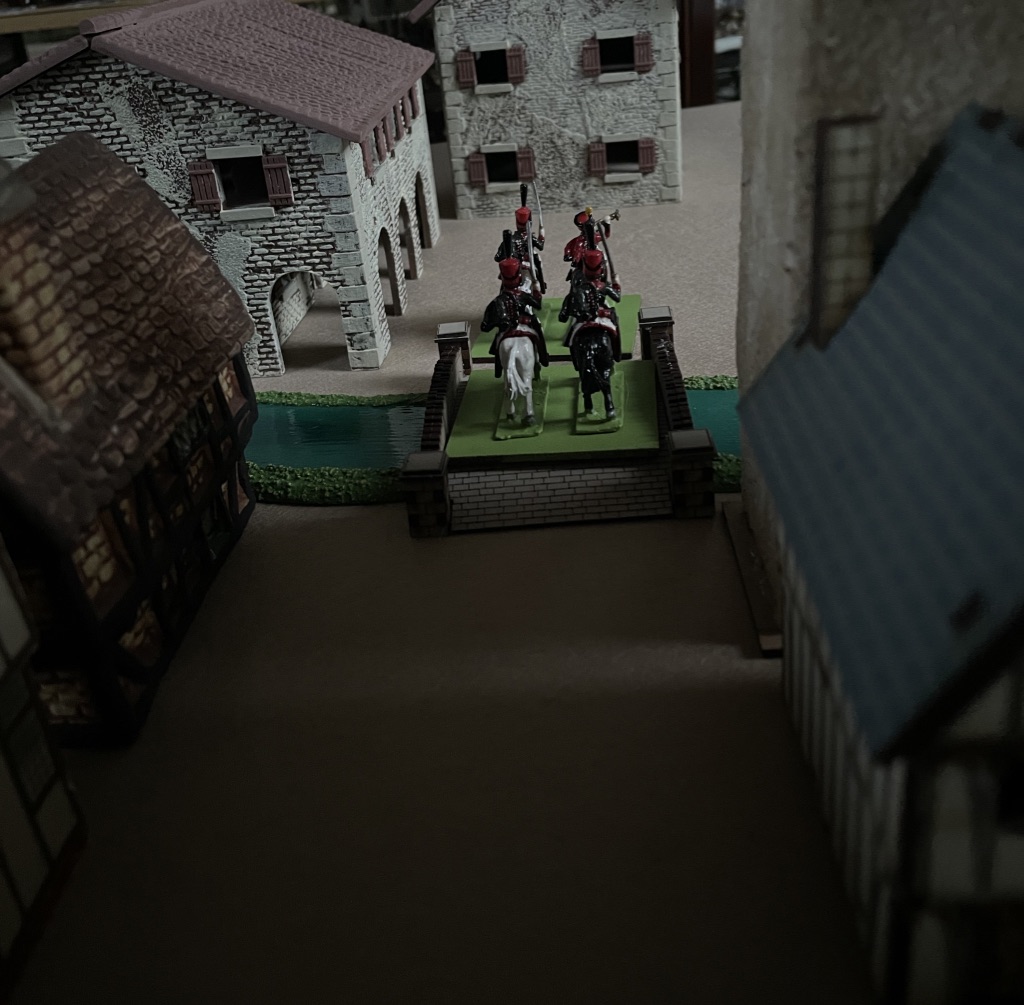
in a last desparate throw Austrian Hussars ride up the main street to halt the Piedmontese tide.
The Hussars beat off the Lancers but to their rear the Artillerists are finally beaten while the East side is alive with Piedmontese. Everywhere Austrian defenders have melted away into the fields or across the bridge.
The Hussars beat a retreat across the bridge bringing to an end the defence of the bridge
Piedmontese Lancers cautiously follow.

The defended buildings were randomly determined and contained one unit each – no other benefits were given the building defenders. So they simply were a delaying factor assisting the mobile defenders fighting outside.

The scenario I played used a 25 step countdown and 1xd6 reduction per turn. The Austrians had to retire at countdown 16 from the edge of town, 7 – the town square and at 0 abandon the north river bank. Victory to Piedmont required they took the bridge before the countdown reached 0.

The game turns 1 to 3 were spent on the edge of town, then turns 4, 5 and 6 fighting over the town square. Turn 7 forced the Austrians back to the north bank but here ended the action as the Austrians actually ran out of defenders.

So the victorious Piedmontese captured the bridge intact and within the timescale set. There were no Austrian Engineers with a lit fuse to spoil their day! Anyway the Austrians would be back soon enough they thought…. Do I hear a Radetzky March in the distance?

For a very old ruleset Joe Morschauser’s rules played easy as I guess you would expect. With the tweaks to aid solo play they actually played very well.

I had bought the rule book for the Grid rules both the originals and Bob Cordery’s modernised version – Bob co edited the book with John Curry.

So this was a pleasant surprise to find a very playable set of “measurement based” rules into the bargain.

Categories
miniatures painting Vienna Treaty Wars wargaming

The Painting Pedestal 22i 1850 Austrians

These Austrians sporting waffenrock full skirted tunics and tapered stove pipe shakoes are really post 1850 . This time I have two weak units representing Infantry Regiments 40 and 41.

IR40 Baron Koudelka 1834 to 1849 probably means the men with light blue facings are from IR40 Inhaber (Ceremonial Commander in Chief) Baron Rossbach who took over in 1850.

IR41 with sulphur yellow facings, under Baron Sivkovich from 1841 then handed over to Baron Kellner in 1857

These are weak Field of Battle Battalions at only 3 bases. Right now I tend to paint the figures by sprue and “Waterloo 1815 manufactured” Austrians come with 10 figures including a mounted officer. So I get 3 bases of 3 foot figures.

I use the excellent Osprey Men At Arms 323 by Darko Pavlovic as my main reference.

Categories
miniatures painting Vienna Treaty Wars wargaming

The Painting Pedestal 22h Austrian Artillery

This Austrian Artillery Battery works for the 1st and 2nd Italian Independence Wars of 1848/49 and 1859/60 respectively. We are still in muzzle loading smoothbore territory but with rifling growing in popularity.

This time I opted for individually based figures.

Previously I had based some of them for Piquet Field of Battle rules.

The artillery pieces are Irregular Miniatures Russian guns.

Categories
1/72 scale figures 20/25/28mm figures Mid 19th Century Wargaming miniatures painting wargaming

The Painting Pedestal: Austrians 1859

My Wars of the Italian Unification (WotIU) see the grip of the former Holy Roman Empire, now the Austro-Hungarian Empire loosened and then effectively removed. Some consider the period to be 1848 to 1866. Others take a more broader approach of 1815 to 1870.

Waterloo 1815 fortunately produced some key figure sets covering the Franco-Austrian War of 1859 – as Italy did not exist! it was not considered a belligerent in this war…….The Kingdom of Sardinia was the junior partner of the French side. To be fair the Kingdom of Two Sicilies (Naples) and the Papal States still sided with Austria.

So Waterloo1815 Bersaglieri should be called something other than Italian for 1859. Strelets call their Bersaglieri Sardinian and are shown in the Crimean War (1854) section by Plastic Soldier Review.

Whichever period you settle on, two dates are signficant. 1848 and 1859. In 1848 it was a last hurrah for the Austrians while in 1859 it was the last hurrah for the 2nd French Empire under Napoleon III. As usual the “Italians” provided the battleground and a lot of suffering.

Thats why 1870 is the best date to view Italian unification when the French were effectively removed from the peninsula as the Prussians marched on Paris.

My 1859 Austrian artillery – two Piquet batteries although I think I might just double them up when I get enough done. 2 guns always “looks” better as a battery on the game table.

During the period 1815 to 1870 the Austrian army infantry uniforms changed from all white with tails, gaiters and helmets or shakoes to white kittels with blue trousers, maybe short gaiters and kepi’s plus greatcoats.

The Osprey Nos 323 and 329 Austrian Army 1836-1866 give you the infantry and cavalry but sadly no artillery. Both authored by Darko Pavlovic these pair are an excellent reference book to get started in this period.

First up are my Austrian Artillery who are made by Waterloo1815 in 1/72 and present in 1859 era uniforms and kit. Plastic Soldier Review was not impressed picking out detail errors plus deciding “the look” was all wrong.

Once you get beyond the Napoleonic period though, apart from the Amercian Civil War, it is like tumbleweed blowing across the painting desk until you arrive at World War 1!

I like the brown and blue uniforms

And Plastic Soldier Review comes up short on ideas for the 1859 Franco-Austro-Italian wars anyway. Just 10 sets on offer.

Having opted for 1/72 and essentially 24mm high = six foot tall real humans, I have made this my problem.

I think the artillery pieces look very good although plastic soldier review were appalled at the lifting dolphins locations.

Dolphins a problem? For the solo wargamer though it is an opportunity – CHANCE CARD – Austrian foundries supply miscast barrel dolphins leading to breakages in handling. D6 for number of batteries unavailable at start of campaign!

In previous posts I have set out my thoughts on figure choice and especially the tricky issue of scale figure height.

metallic normans in the south at 1/72

Given that 28mm scale which is relatively new could not establish some fixed limits then I think the rule is always “if you like it go with it”.

Back to these Austrian Artillerists. They will do for me and as it happens I quite like the quirky design style with their tall kepi’s balanced on their moustachieoed heads.

Now where are those Infantry?