John over at just needs varnish shared his latest Ork which by all accounts was fortuitous – it was fortuitous for me as I restled with the lack of Orks or Orcs among my Danes, Germans, Austrians and Italians of the mid 19th century (there is another game in there somewhere I am sure………..)
So then I glanced at my cabinet – lucky enough to have a permanent display. And low and behold I saw some Orcs.
This neatly tied in with my recent trip to Barnsley and the Lord of the Rings event that runs till April 2024.
well I never…..well I never again….had the album but never even gave it a second thought – duuuurrrrrrrThe one ring unguarded!Plenty to see and do around Barnsley – the whole museum is free
You will have to see the exhibition to enjoy its contents – its free and so is the first 3 hours parking in the centre of Barnsley 5 minutes away! Trains, buses, trams nearby as well.
Here are those pesky Orcs. They date from mid 1970’s in the days when White Dwarf editions were in their teens I seem to remember. I was absorbed by D&D for a few years then simply left the whole hobby thing altogether. The figures never got disposed of and lived in various boxes biding their time. They still are biding their time but have a sentimental place in my display cabinet.
The figures are forest orcs from Miniature Figurines.
Their purchase also coincided with my oil painting experiments, humbrol enamels being the standard painting method. These chaps have a mix, the green skin is in oils with yellow highlights while the mail and shields are in enamels complete with some dry brush. Oh and the spear wood was in gouache for some reason.
The Lord of the Rings Exhibition at Barnsley Museums Trust was an enjoyable step back in time – the event focuses on how every type of media shared and promoted the stories. Yes there are model orcs…… Some well thought out and detailed text compliments the various items on show. Of course the one ring is there but strangely unguarded………….hang on those pesky orcs have run off, I wonder where.
I had previously encountered Bob’s grid rules in the History of Wargaming publication of Joe Morschausers early 1960’s book on wargames. Although a contemporary of Donald Featherstone, Joe’s rules better resonate with 21st century rulesets in my view.
This purchase collided with my stop-start diversion into “pound store warriors” and ultimately a bit of sci fi gaming. Man of Tin had been instrumental in starting me to look at these figures that did not even look like green army men. It is a measure of my lack of progress (the figures arrived during lockdown……) that my recent first game only fielded half a “sci-fi” set up. Some WW2 Russians and Americans filled in as opponents and neatly delivered the unexpected scenario and indeed a back story into the bargain.
Captain Parker of the US 21st Army held the edge of Exetown along the river Exe. In the town were the Russian 33rd Army forces led by Senior Lieutenant Yashin.
The front such that it was involved nothing so much as a watching brief. There had been “no action” when the two forces had closed up to each other – just looking and with even the odd conversation exchanged across the river.
When the Russians were surprised by the Aliens in Exetown all that changed, Yashins troops just ran hell for leather at the Americans who fortunately hesitated to fire long enough to spot the new enemy beyond. Somehow the Americans could sense that the Russians were not trying on a surprise attack – they were genuinely running for their lives.
So the scenario made itself – The renewed Allies have to fight off the Aliens and at least hold the river line. The Aliens have to drive the humanoids off the table.
Rules
Rules used were The Portable Wargame by Bob Cordery. I used the solo option.
Only rule change of note was to assign the “alien blasters” 5 dice per firing round. So they were like super heavy machine guns in effect. But they had only a grid range of 2 instead of 3.
I also permitted some unit size differences. The Aliens had fewer units but 4 or more figures per unit. The Allies were basically 3 man units.
In the event the Allies had a higher break point for exhaustion yet got there quicker as their units were destroyed more easily.
I had just played a game so had the table set up plus some figures that in turn fed the scenario and storyline. My grid was 8 long x 12 wide, using 6 inch (150mm) grids. Not very portable!
Opposing Forces
Allies (Exhaustion Point is at 6 units left)
American (First Lieutenant Osteen)
CO unit 3 figures
rifle squad 3 figures each
rifle squad
rifle squad
rifle squad
rifle squad
Russian (Senior Lieutenant Yashin)
CO unit 2 figures
Machine gun unit 2 figures
machine gun unit 2 figures
rifle squad
assault squad
rifle squad
Aliens (Exhaustion Point is at 3 units left)
Blue Troop (Colonel Blue)
Colonel Blue and Heavy Machine Gun 2 figures
Blaster unit A1 3 figures (one figure armed with what looks like a bazooka)
Blaster unit A2 3 figures (one figure armed with what looks like a bazooka)
Yellow Troop (Colonel Yellow)
Colonel Yellow unit
Attack unit A3
Attack unit A4
What happened?
First up – the Allies (US/Russian) threw high in the first 6 moves for “first to move”. The Aliens took heavier losses as they advanced, then at close range they began to wear down the Allies. Exhausted the Allies had to hold their line and so my scenario backstory kicked in and the allies retired rather than simply continuing to hold under the rules.
So a new ruleset, some abandoned figures and also a new grid surface** combined with a storyline from nowhere, resulted in an excellent game.
The game played out in 12 moves and took half a day as I left it quite a few times to do some real life activity! So I guess maybe it took about 1 hour to 1h30m to play the 12 turns including set up and take down. Remember I already had the table set and in fact the US/Russian troops were from that game.
I suspect that this sort of game is easily a one hour set up, play and put away operation.
Biggest impact for me was the ease of play and how it simply connected with my rather mad scenario. So very high on the Enjoyment scale.
Here are some episodes from the game.
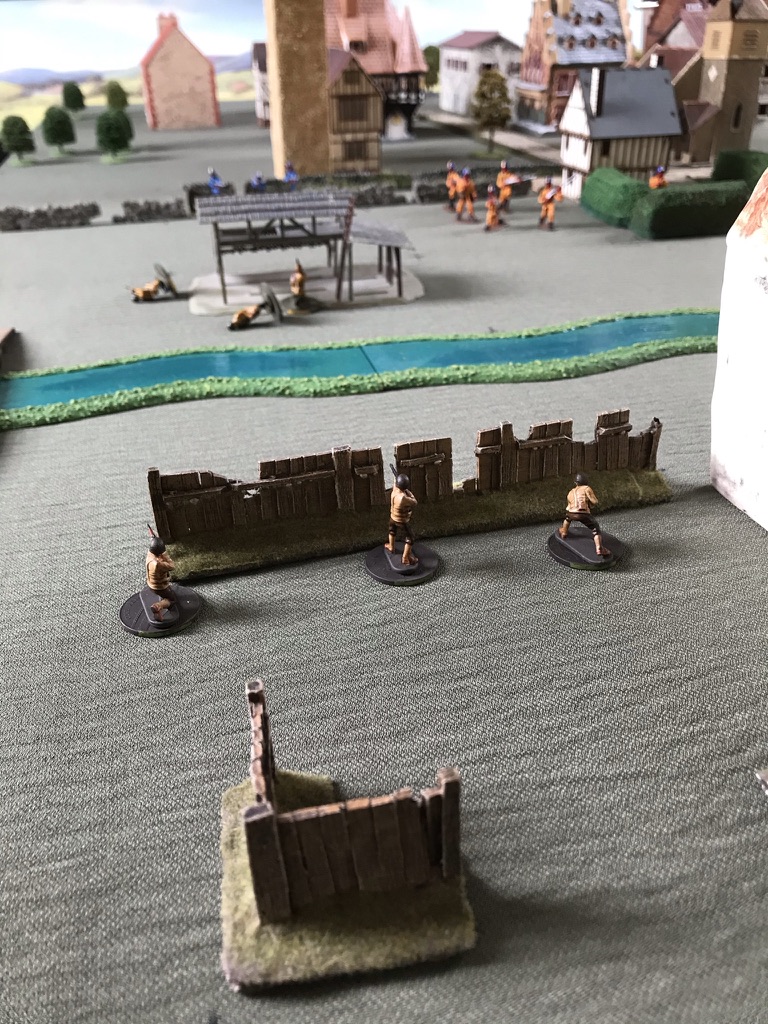
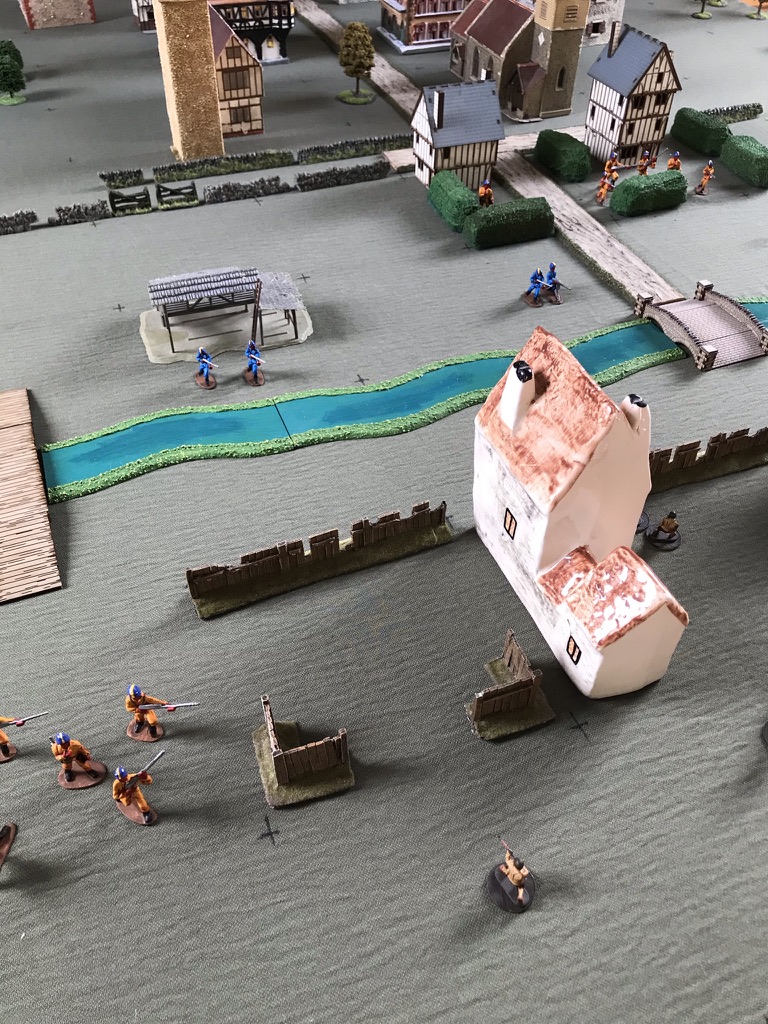
The Russians race across the bridge towards the stunned AmericansAs First Lieutenant Osteen gathered his men Senior Lieutenant Yashin called his men in and sent a squad to the sawmill.Lieutenant Yashin finally gets a sighting on what appear to be different types of enemy foot soldiersA brisk firefight at the edge of town as the Russians retreat across the unfordable river Exe by the main bridgeThe enemy pursue the russian squad to the sawmillOn the right flank the US troops, in the morning sun, began to get a sighting of their opponentsagain what seemed to be a mixture of enemy troops in their bright uniforms loomed into view
The brightly uniformed enemy had been easy targets and the allies gained an early advantage decimating the orange unit that tried to reach the main bridge first – the remnants retreated to the hedged half timbered house where they stayed for the remainder of the battle
The defenders in the sawmill got a shock as the blue unit and orange units combined fire felled many russiansIn the centre the firefight was heating up with one Lieutenant Osteens squad falling victim to the accurate enemy fire. On his right the remaining russian machine gun team continued to stop any enemy advance on the bridge.As Yashin crossed over to the now threatened right flank a US squad took aim at the enemyin the open the allies were decimated – Petrov and Lefebvre fell hereThings were going from bad to worse on the right flankAnd now on the left flank the orange unit stormed over the foot bridgein the centre it was still a stand offYashin managed a counter attack on the right which drove back the blue blaster unit and weakened the orange unit.but the enemy responded in turn and Yashin fellOn the left flank the footbridge looked lost as the US defenders were being overrunbut a heroic effort by the left and centre threw the enemy back, they even silenced one of those dreaded “blasters”only for the enemy to attack again – the last allied squad moving up to the footbridge at that momentThe uneven contest at the footbridge was short and the allies lost and with it their left flank as well
With both flanks destroyed Osteen, Kachalin and the remnants of both Russian and US combat teams retreated from the field.
The Aliens move on the main bridge over the River Exe as Osteen prepares to retreat.
* – tacfos or “the aliens came from outer space!”
**- for this game I used one of my new grid sheets. I have been experimenting with different surfaces when it comes to grid games. Like most Board games, the grid surface is integral to the game. So I have not yet settled on the best grid surface for any one game. Given I have quite a few cloths and boards for my “measured” table top games this should come as no surprise.
The empty field – the trees wonder what will happen next?
In part 1 we encountered 1940’s action between Americans and Russians on some unknown wargames table………………..
Osteen and Yashin briefly discussed the situation….. “who the hell are those guys Yashin?” “Lieutenant Osteen your guess is as good as mine – they appeared from nowhere and started shooting”……..
Just then a bloompf – “what the………..Drabowsky report!” Luis Drabowsky scrambled across to his Lieutenant, right now he could not get used to rubbing shoulders with these Rushkies: OK so they had fought the common enemy but now it was 1946 and a deteriorating stand off existed between the former allies.
Meanwhile Senior Lieutenant Gregori Yashin rushed over to one of his squads led by Sergei Petrov. “What was that? that noise Petrov?” “Senior Lieutenant the enemy have some sort of energy weapon – there was muzzle flash and then an unusual airburst – our men were dazed but that is all…..” Yashin nodded then ordered Petrov to organise the right flank with his new american comrades.
“We will make good communists of you Johncheeses yet” laughed Junior Sergeant Eduard Kachalin – Sergeant Wes Lefebvre was about to respond when fire erupted all along the line, “Kachalin, it looks like we will have to delay our discussion!”. The two men scuttled off to organise their squads.
The fighting was quick and one sided, the renewed allies withdrew from the edge of town as their new common enemy forged towards them.
As Osteen withdrew in the centre he met Kachalin, one of the good english speakers amongst the Russians………”Hey Kachalin where is Yashin?”, ” Kachalin between gasps “Lieutenant, he fell, they got him,,,,, he stood no chance” – Osteen – “damn, damn these monsters……..”
Captain Parker repeated his statement again “yes sir we have been attacked by a superior enemy – we have retreated from sector 6, repeat we have retreated from sector 6…………the russians? the russians are with us sir………….I can explain sir, no sir they fought with us, sir, sir……..”. “Yes Lieutenant Osteen is one of my best men – solid and dependable………..yes sir I know this hard to take………….no this is not, I repeat not a russian trick………”
“Damn it Barnes where is that link to Osteen?” Sergeant Barnes groaned – “nothing sir, nought, zilch……”
The noise of guns and other weapons invaded Captain Frank Parker’s mind – then he realised they were for real.
“Roseborough call up the jeeps we are moving, Barnes radio we are pulling back to sector Y zone 3A”
Just then a massive noise erupted near Parker/Roseborough and Barnes.
They rose dazed but uninjured. Nearby others were not so lucky.
Later in sector Y zone 3A Parker listened …..”so you see sir its an ASF situation with probably a RIM aspect……….”, “cut the crap Kouffax – give it to me in words……” Kouffax took a deep breath and continued ” Well sir it looks like an ASFI, I mean an Any Scale Figure incursion and involves Rogue Injection Moulded forces…..” meaning what exactly?” – Parker being now completed exhausted by the whole mess. Joe Kouffax took another breath, “well sir we have contacted OTO…” stop stop! “what/who is OTO” – Parker was exasperated. “well sir he is the One to One scale operator, we think there has been a WTMU, I mean a wargames table mix up”. Parker was lost for words as the line went dead………..
Barnes was incredulous “so Sir we were fighting the wrong forces? they were in the wrong place – sorta like a time travel event? and this OTO guy, he sorted it all out……….”
Parker gazed at the sky “…….Barnes……….yes, yes for gods sake if you like………anyway it is all SNAFU”. “Barnes get me Osteen on the line I want to know he got those new Russian friends off his back, that they are on their side of the line….”
So having had a good start to the year painting wise, by August I had enough units to do some gaming. My wargaming has always been predominantly “solo”, so road testing rules on my own is natural for me.
Impetus elements of Anglo Saxons, Carolingians and Normans ready to do battle
I should also say that from my earliest wargaming days I have tinkered with rules.
It is a quirk of fate that the first wargames book I read on rules came from my local public library (remember them?). So being a child you take what you can or rather see. So what did my local library have in the adult section? Well a single Donald Featherstone book. And his book was called “Advanced Wargames”. It was a book about wargames and the advanced bit meant nothing to me.
years after my public library discovery I bought my own copy of this book. It actually contains material that has been “invented and popularised” decades later such as grid gaming
So armed with Advanced Wargames I started rule based wargaming and of course met a big problem. Advanced Wargames is a set of chapters dealing with “aspects” of wargaming. Drawing on multiple sources and authors the book covers most areas of rulesets yet they are not joined up to provide a single useable ruleset.
The assumption was that you had a wargames ruleset/s already and some prior knowledge of the whole idea of rules based wargaming. Then you would cherry pick additions and improvements from the book.
I think this is the origin of my “tinkering” with wargames rules. Give me a set of rules and I will invariably add in some “house rules”.
So back to my road test of the rulesets of Neil Thomas and Daniel Mersey.
I have posted previously about my reluctance to move from seriously thought out but quick DBA into the very simple world of AMW. Yet this ruleset is very enjoyable and is more subtle than you might think.
In Ancient & Medieval Wargaming (AMW) by Neil Thomas there are four period rulesets
Biblical Wargaming 3000BC – 500BC
Classical Wargaming 500BC – 300AD
Dark Age Wargaming 300AD -1100AD
Medieval Wargaming 1100AD – 1485AD
My choice here was obvious – Dark Age Wargaming.
I used his rules without house rule changes on this occasion. Well with one exception.
I use Impetus sized elements having abandoned DBA with its restrictions on depth. And I had settled on 1/72 20-25mm figures on 80 mm wide bases which Impetus assumed would be for 15mm although the rules clearly gave you the option for 1/72 basing.
In fact Impetus rules whole approach to basing was so refreshing when I encountered them. And for me they have set the tone for most of the last decade.
I think they were in the vanguard of “BW” measurement or base width’s. This simple decision meant the end of the need to “rebase” figures when switching between rulesets. Of course if you only have one ruleset it is never an issue.
I have almost as many rulesets as guides to painting figures if not more……..dozens.
AMW assumes you have DBA based figures so uses 4 40mmx20mm bases giving you an 80mm x 40mm element and 8 of these make an AMW army.
In effect you need 32 dba bases which is not so good if you have 12 unit dba armies: And most of my thinking had been on these compact DBA army lines.
table size and figure basing all go together for me. I fixed my maximum table size at 6’x4′ imperial and 1.8m x 1.2m metric. 3 collapsible picnic tables from lidl are the foundationsurface finish is 3 x 20mm thick mdf 4’x2′ (1.2m x 0.6m) boards to minimise warping covered with felt in this case
Then I read an article in the Lone Warrior magazine of the Solo Wargamers Association. There the writer suggested a cheap way to build armies was just use the 40mm x 20mm bases as single elements and/or reduce figure count to just say 1 for light troops, 2 for medium and 3 for heavy troops. Well it was something like that because it was the principle that made the difference to me. It broke me fully away from DBA “figures per base rules” and Impetus gave me the solution of 1/72 figures which I prefer – yet now on a smaller 15mm scale base size I also prefer.
The net result is I use 80mm wide bases and actually a generous 60mm depth for all units. This allows the impetus suggested “diorama” approach, better showing individual figures you have carefully painted rather than their being very squashed together under DBA.
You sacrifice ground scale though. I guess in this I have followed favourably the increased “abstraction” approach on ruleset design. Abandoning figure removal for losses in the 1990’s? was the start of this “abstraction” and for some the descent fully into gaming and away from any simulation. I love history yet I love gaming so the compromise matters.
Neither AMW nor Dux Bellorum require explicit command bases but I like them so here is one – from my much delayed “Normans in the South” project – none other than Tancred d’Hauteville looking at the shield design.
Using single base elements meant that required base removal in AMW rules was not now possible. The fix here was simply to use two dice. The first was used to show the 4 “virtual” bases while the second showed the 4 points value each virtual base could sustain before being knocked out and removed from play. I have also used three dice in other games (18 so showing 6+6+4 at the start). But the rules in AMW use base counts to indicate available attack dice. Unless you like mental arithmetic, showing the two aspects gives a simple visual indicator.
A few years later Neil Thomas used this “one number” technique to good effect in his fastplay “One Hour Wargames” (OHW) rules where units are a single base elements with a value of 16 which equates to all the elements morale/resistance/casualty value and overall strength in one number.
With AMW you need not fear flank issues so the shieldwall has gaps between each element/unit ! you can of course place units in base to base contact – i was reflecting the AMW book diagrams!
So I played two games with AMW. The first was essentially two shield walls crashing together and the second was a cavalry led force attacking a shieldwall.
The mighty Norman/Carolingian or Franks in AMW speak start their assault on the Anglo Saxons shieldwall. AMW give suggested army set ups although you still have plenty of choice in the small army lists in the text
The third ruleset test game was another shieldwall versus shieldwall this time using Dux Bellorum.
atmospheric artwork throughout the Osprey book makes its use feel positively different to the text heavy AMW where a central batch of irrelevant but professional model armies fails to add any real value. The AMW font is bigger so the text is much easier to refer to in the heat of battle though!
These rules are aimed at a narrower period AD367-793 and with a nod to fantasy gaming called “Arthurian Wargaming Rules”. These rules use the “BW” concept, being published in 2012, 5 long years after AMW.
a solid pair of shieldwalls square up for Dux Bellorum. The dice are colour coded for the unit grades such as “nobles”.
Again there were no tweaks for once. Indeed in both cases as I fought shieldwall battles a side benefit was to better understand the design of these two rulesets. Because shieldwalls in both rulesets result in quite a static and very balanced game you can see the effect of a limited number of the author’s variables in action.
Here is an Anglo Saxon Command with to its front my version of a shieldwall in 1/72 Strelets plastics on an Impetus 15mm scale 80mm wide element base.
In my next blog I will consider what happened in each game.
the ring and dice combination solved my AMW rule problem when using only base instead of 4.






 The Wargaming Erratic