Categories
Vienna Treaty Wars wargame rules wargaming

On the Grid with Post Napoleonic

I have revisited some grid based wargames rules I used with some success last year in my shieldwall battles.

This time they are dealing with post Napoleonic Warfare.

Rules: Table Top Battles now branded for GRID Wargaming by Mike Smith and I was using a 50mm grid style table just slightly bigger than the one used in the rules.

You will notice that I like asymmetrical forces wargaming which is essential if you are to enjoy solo campaigns.

Narrative: Zarland is in crisis with the succession challenged and neighbouring countries all seizing opportunities!

Davaria, located south west of Zarland, decide it is time apply some pressure and march on Zarland.

General Jacapo Guarnieri led a strong force to the border. Meanwhile the Regent dispatched General Jenthe Knees with a hastily gathered force to hold the river Plima. General Knees at least had the good fortune to discover the likely crossing point of the Davarians.

He bivouacked his troops around the village of Menas.

He had with him

  • 4 units of Hussars
  • 6 units of Infantry mostly untried militia
  • 2 field guns

As the morning mist drifted off the river Plima General Knees viewed the arrival of the Davarians, who had been marching since just before dawn.

General Guarnieri had the following troops at his disposal. Many of his light troops were away foraging, sorting logistics and scouting. The irregulars were probably just sleeping under some trees!

  • 4 regular infantry units
  • 4 regular heavy cavalry units
  • 4 field guns

General Knees ordered his Zarland cavalry forward to test the Davarian left wing marching against the north Menas bridge. He posted the rest of his forces on the defensive.

General Guarnieri ordered his troops forward to take both bridges and force a crossing. The river here was narrow but with steep banks, difficult to cross. The Davarians planned to keep their feet dry.

The Zarlanders on the right have put together a scratch force with many new or militia units. They are trying to hold the river and prevent the Davarian forces securing a crossing to exploit.
The Zarland Hussars recklessly charge the enemy guns which are withdrawn. The success of the Zarland Hussars is shortlived as they encounter Davarian foot with some Davarian cavalry arriving on their flank.

Meanwhile the Zarland militia do well to repulse the Davarian Foot who try to rush the south Menas bridge.

Eventually the battle ends in stalemate at the south bridge as the Davarian Infantry can make no headway here. The north Menas bridge though is now exposed by the loss of the Zarland hussars who are driven off to the North West.

General Knees uses the cover of dusk to abandon his positions. The Davarian Commander General Guarnieri has secured his objective.

I used the standard rules plus elements of the solo rules section. The rules are a really useful halfway house for campaign battles where to set up a full game is not possible but dicing for a result is too blunt.

I have become a lot more amenable to grids – Peter Pig was my first enjoyable exposure (Rules for the common man) especially since I have simply never managed to like large hex wargames where I just feel its a blown up board game. Peter Pigs grids were almost invisible – excellent. Mike Smith’s grids are for me a happy compromise.

Categories
Mid 19th Century Wargaming wargame shows wargaming

Virtual VAP21 : a wargame ruleset

I guess I have become an accidental acolyte for Neil Thomas. Why?

In wargames rules terms we live in an era where there are “gazillions” of rules. There are probably AI engines knocking them out these days: I am of the view that wargaming is the multi billion dollar hobby that includes every online gaming app from fortnite to defend the cauliflower patch from aliens (ok I made one up). Miniatures is just an oxbow lake in this mighty river of gaming. And this particular oxbow lake is up to its ears in rulesets for miniatures gaming and seems to love it.

So who needs another ruleset and especially one that is so “retro”?

I do.

Sometimes you have to go back to go forward and just sometimes you can go back and rework an idea using more recent thinking to go somewhere else instead.

I like Neil Thomas rules because there is a hint of Donald Featherstone in his thinking. He is quite direct in his writing – this is useful – and his approach is to apply the right amount of abstraction.

It is quite interesting to reread Donald Featherstone occasionally. For example one of his books is ladled with “scale” as in movement, time and distance: yet Donald says at one point he would rather just approximate matters so he can get on with the game – a battle. The book is his offering on Wargame Campaigns!?

This is my key to Neil Thomas. He wants you to play games and specifically battles. That is his endpoint, the outcome desired.

Neil’s book “Wargaming Nineteenth Century Europe 1815-1878” delivers battles using miniatures. It starts at the end result and is designed to give you a game in a space – typically 6’x4′ or 1.8m x 1.2m and very often less.

Neil presents his take on the various elements that defined the era and then puts all these into a neat package of rules that are brief and to the point.

The rules mechanisms are familiar to those who have his other rules to hand. Not too many and simplicity is the order of the day.

I think the important thing about his rules are what he leaves out – which of course you need to fill in – so abstraction is all.

Neil normally achieves a balanced asbtraction in his rules. They feel right to me. So did I like these rules?

A qualified YES, I have only used them once after several rereads of the book itself.

If Neil Thomas were an artist I would fancy his work would look like this – a detailed landscape of a pretty coastal port
I do not think Neil would be offering you this much detail as an artist. Just look at that sky as well.

Both paintings are to be found in the excellent Hull City Ferens Art Gallery: Go visit when lock down ends.

The rules come with scenarios and cover all the key changes in weapons and fighting that occurred from the demise of Napoleon to the Russo-Turkish war of 1878. His rules are so abstract or rather to the point, that technology changes like the railway and telegraph get little mention. Actually covering this periods scope in itself is quite a feat – a bit like a ruleset mixing Napoleonic, AWI and most of the Seven Years War yet along with significant weapon/technology changes.

In 2020 I was at the Lance and Longbow Society stand where Lithuanians and Poles were fighting it out with the Teutonic Knights at the battle of Tannenburg (1410). There were live opponents that day.

For Virtual VAP 2021 I have time warped to around 1850 to play a solo battle.

My latest project is about the Wars of the Italian Unification (WotIU). The outlier campaign is 1848 when the world also first saw Garibaldi play a signficant role in the peninsula.

By 1859/60 Garibaldi was ready for a star role leading 1000 red shirts driving out the Two Sicily’s Kingdom troops from Sicily in short order. I have already discovered some new aspects in my expanded reading on this fascinating period: That Naval muscle helped him was a surprise. And there seems a varied range of battle situations with the red shirts not having it all their own way.

The real wars seem to be fascinating. I normally like to fight with “imagination” forces which offer freedom to generate many battles and situations without the confines of “well that happened next”.

My WotIU armies are still “under the brush” so to speak. This means my game is populated with what is to hand. And the protaganists are the elusive “Empire” and “Kingdom”.

Back to the rules. I chose to start with the early period set – 1815 to about 1850. Smoothbore muskets and cannon. So pretty much Napoleonic era kit.

I had bought the “e book” as a limited dip in the water for a new period. I struggle with using rules in this format even though it is quicker to flick the pages!

So I wrote out on two sides of A5 the rules that seemed to matter.

When you look at them they amount to about a quarter page on movement, a quarter on firing and half on close combat plus a bit on morale.

Neil parcels up his principles clearly even if my scratty writing undoes some of this!
So on one side of A4 (2xA5) you have all the rules for a game – neat – unlike my writing

So the usual fare then from Neil. Neil likes his saving throws and uses this double dicing to achieve some of his flavour/depth or granularity. So even though for solo play it seems avoidable this step provides a bit of subtle ebb and flow.

Both the Empire and the Kingdom fielded “Monarchist” armies.

I will run through the resulting battle in my next post.

Categories
Mythical Realms wargaming

Mythical Realms

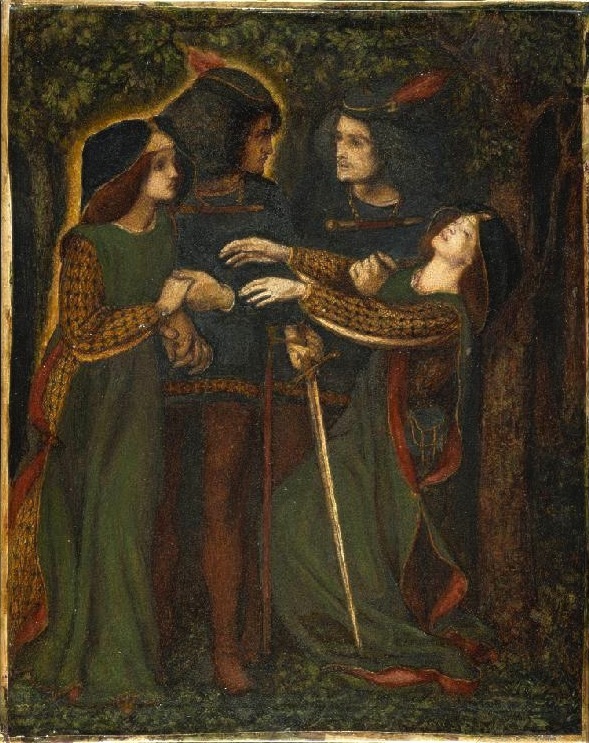
https://upload.wikimedia.org/wikipedia/commons/2/2d/Dante_Gabriel_Rossetti_-_How_They_Met_Themselves_%281860-64_circa%29.jpg
https://dantisamor.wordpress.com/2014/01/14/how-they-met-themselves-pre-raphaelitism-and-the-double/

What happens when you meet your doppelganger?

Actually it is best not to.

In my case – creating a Mythical Realm is not normally a problem because I tend to invent some totally separate location that just happens to have the same oxygen, societies, nature, science and warfare of the period I want to plunder.

And then occasionally real history just cries out to be used. Italy is a regular case in point for me. Most recently I was on a Normans in the South (NitS) splurge before crashing into Faux Napoleonics by Renaissance Troll.

One thing has led to another and one minute I was on the Wars of the Italian Unification (WotIU) – kepis, garibaldi and kettels, next I am thinking how to do Napoleonics without Napoleon, Wellington or Blucher etc.

Well I have solved the problem – it is a Vardoger Planet – ok maybe it is a sort of doppelganger.

The story is this.

Once upon a time there was a planet – called Earth and in front of it so to speak was another planet called Earth which experienced everything just that bit earlier. And so the worlds trundled along except that one day there was a small ripple and it was a very small ripple.

No one noticed because no one knew. Well I guess someone knew because I would not be telling you this.

We live on the first planet, or lead planet. The “Vardoger” one. Now our following planet is just slightly different.

Welcome to “Fauxterre” where things are just slightly different.

https://upload.wikimedia.org/wikipedia/commons/d/df/QSH_Tin_Wind_Up_Astro-Scout_Doppelg%C3%A4nger_%28Journey_to_the_Far_Side_of_the_Sun%29_Movie_Homage_2.jpg
D J Shin, CC BY-SA 3.0 https://creativecommons.org/licenses/by-sa/3.0, via Wikimedia Commons