Categories
Mythical Realms wargame rules wargaming

Painting Pedestal 23X: Tacfos* – the game – episode 3

Over the summer I renewed my interest in grid gaming and eventually bought the very popular Portable Wargame Rules by Bob Cordery.

I had previously encountered Bob’s grid rules in the History of Wargaming publication of Joe Morschausers early 1960’s book on wargames. Although a contemporary of Donald Featherstone, Joe’s rules better resonate with 21st century rulesets in my view.

This purchase collided with my stop-start diversion into “pound store warriors” and ultimately a bit of sci fi gaming. Man of Tin had been instrumental in starting me to look at these figures that did not even look like green army men. It is a measure of my lack of progress (the figures arrived during lockdown……) that my recent first game only fielded half a “sci-fi” set up. Some WW2 Russians and Americans filled in as opponents and neatly delivered the unexpected scenario and indeed a back story into the bargain.

Captain Parker of the US 21st Army held the edge of Exetown along the river Exe. In the town were the Russian 33rd Army forces led by Senior Lieutenant Yashin.

The front such that it was involved nothing so much as a watching brief. There had been “no action” when the two forces had closed up to each other – just looking and with even the odd conversation exchanged across the river.

When the Russians were surprised by the Aliens in Exetown all that changed, Yashins troops just ran hell for leather at the Americans who fortunately hesitated to fire long enough to spot the new enemy beyond. Somehow the Americans could sense that the Russians were not trying on a surprise attack – they were genuinely running for their lives.

So the scenario made itself – The renewed Allies have to fight off the Aliens and at least hold the river line. The Aliens have to drive the humanoids off the table.

Rules

Rules used were The Portable Wargame by Bob Cordery. I used the solo option.

Only rule change of note was to assign the “alien blasters” 5 dice per firing round. So they were like super heavy machine guns in effect. But they had only a grid range of 2 instead of 3.

I also permitted some unit size differences. The Aliens had fewer units but 4 or more figures per unit. The Allies were basically 3 man units.

In the event the Allies had a higher break point for exhaustion yet got there quicker as their units were destroyed more easily.

I had just played a game so had the table set up plus some figures that in turn fed the scenario and storyline. My grid was 8 long x 12 wide, using 6 inch (150mm) grids. Not very portable!

Opposing Forces

Allies (Exhaustion Point is at 6 units left)

American (First Lieutenant Osteen)

  1. CO unit 3 figures
  2. rifle squad 3 figures each
  3. rifle squad
  4. rifle squad
  5. rifle squad
  6. rifle squad

Russian (Senior Lieutenant Yashin)

  1. CO unit 2 figures
  2. Machine gun unit 2 figures
  3. machine gun unit 2 figures
  4. rifle squad
  5. assault squad
  6. rifle squad

Aliens (Exhaustion Point is at 3 units left)

Blue Troop (Colonel Blue)

  1. Colonel Blue and Heavy Machine Gun 2 figures
  2. Blaster unit A1 3 figures (one figure armed with what looks like a bazooka)
  3. Blaster unit A2 3 figures (one figure armed with what looks like a bazooka)

Yellow Troop (Colonel Yellow)

  1. Colonel Yellow unit
  2. Attack unit A3
  3. Attack unit A4

What happened?

First up – the Allies (US/Russian) threw high in the first 6 moves for “first to move”. The Aliens took heavier losses as they advanced, then at close range they began to wear down the Allies. Exhausted the Allies had to hold their line and so my scenario backstory kicked in and the allies retired rather than simply continuing to hold under the rules.

So a new ruleset, some abandoned figures and also a new grid surface** combined with a storyline from nowhere, resulted in an excellent game.

The game played out in 12 moves and took half a day as I left it quite a few times to do some real life activity! So I guess maybe it took about 1 hour to 1h30m to play the 12 turns including set up and take down. Remember I already had the table set and in fact the US/Russian troops were from that game.

I suspect that this sort of game is easily a one hour set up, play and put away operation.

Biggest impact for me was the ease of play and how it simply connected with my rather mad scenario. So very high on the Enjoyment scale.

Here are some episodes from the game.

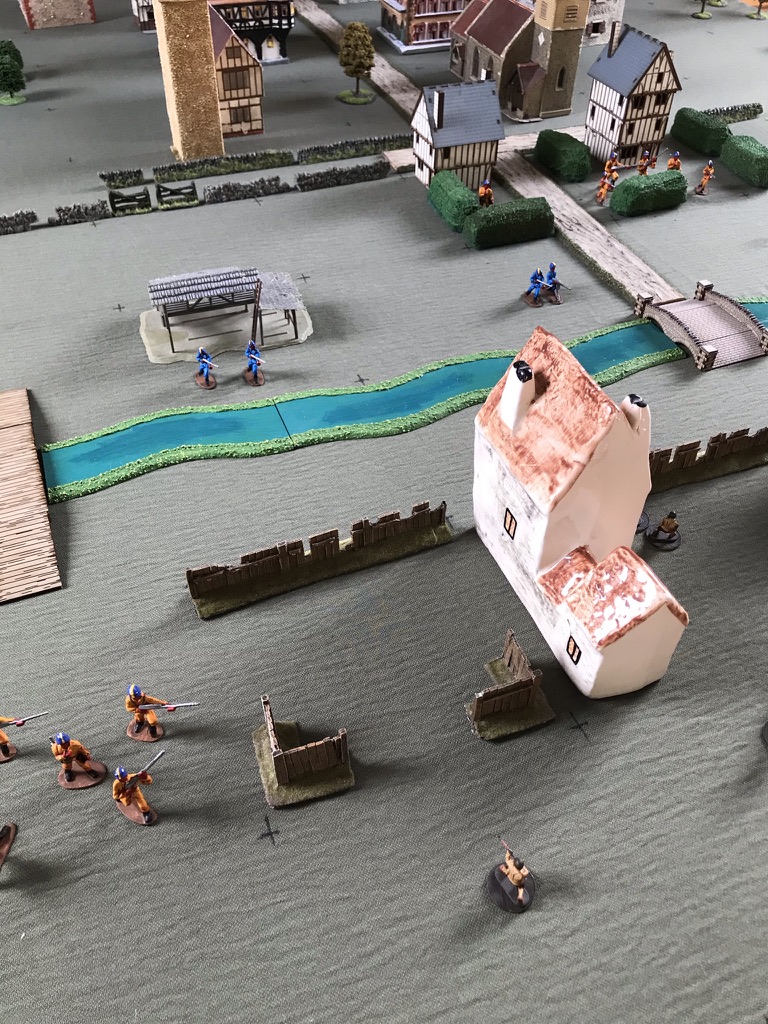
The Russians race across the bridge towards the stunned Americans
As First Lieutenant Osteen gathered his men Senior Lieutenant Yashin called his men in and sent a squad to the sawmill.
Lieutenant Yashin finally gets a sighting on what appear to be different types of enemy foot soldiers
A brisk firefight at the edge of town as the Russians retreat across the unfordable river Exe by the main bridge
The enemy pursue the russian squad to the sawmill
On the right flank the US troops, in the morning sun, began to get a sighting of their opponents
again what seemed to be a mixture of enemy troops in their bright uniforms loomed into view

The brightly uniformed enemy had been easy targets and the allies gained an early advantage decimating the orange unit that tried to reach the main bridge first – the remnants retreated to the hedged half timbered house where they stayed for the remainder of the battle
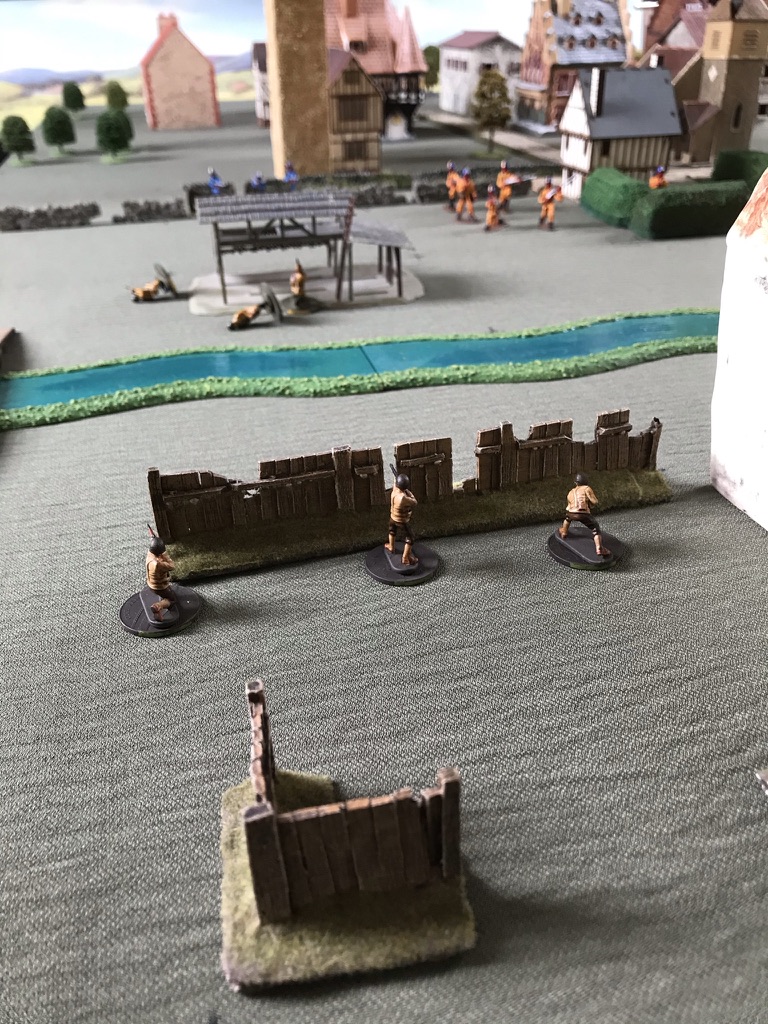
The defenders in the sawmill got a shock as the blue unit and orange units combined fire felled many russians
In the centre the firefight was heating up with one Lieutenant Osteens squad falling victim to the accurate enemy fire. On his right the remaining russian machine gun team continued to stop any enemy advance on the bridge.
As Yashin crossed over to the now threatened right flank a US squad took aim at the enemy
in the open the allies were decimated – Petrov and Lefebvre fell here
Things were going from bad to worse on the right flank
And now on the left flank the orange unit stormed over the foot bridge
in the centre it was still a stand off
Yashin managed a counter attack on the right which drove back the blue blaster unit and weakened the orange unit.
but the enemy responded in turn and Yashin fell
On the left flank the footbridge looked lost as the US defenders were being overrun
but a heroic effort by the left and centre threw the enemy back, they even silenced one of those dreaded “blasters”
only for the enemy to attack again – the last allied squad moving up to the footbridge at that moment
The uneven contest at the footbridge was short and the allies lost and with it their left flank as well

With both flanks destroyed Osteen, Kachalin and the remnants of both Russian and US combat teams retreated from the field.

The Aliens move on the main bridge over the River Exe as Osteen prepares to retreat.

* – tacfos or “the aliens came from outer space!”

**- for this game I used one of my new grid sheets. I have been experimenting with different surfaces when it comes to grid games. Like most Board games, the grid surface is integral to the game. So I have not yet settled on the best grid surface for any one game. Given I have quite a few cloths and boards for my “measured” table top games this should come as no surprise.

The empty field – the trees wonder what will happen next?
Categories
Mythical Realms wargame rules wargaming

Fauxterre 1816: Part 6 Running the Rule over Kloster Arens

The Neil Thomas ruleset 19th Century European Wargaming (NT19e) has quickly become a favorite of mine, stoking an interest in an era that frankly I have never read about since I was taught, as a kid, about some mad British Cavalry charging Russian guns in a place called Crimea. And not knowing that the French and Prussians rehearsed world war 1 44 years early, in 1870, as well. I did learn about the American Civil War – but that was on a different continent, so doesn’t count.

Neil Thomas restricts his interest to the evolution of European Wars over a 60 year period.

Day 1: I used Neil Thomas NT19e to run a mini game between the advance guards

My original european wargaming interests ended at Waterloo in 1815, with Napoleon and then restarted in 1939 with world war 2.

Neil Thomas provides a comprehensive ruleset for battles between 1815 and 1877. Indeed he covers campaigns in a way not really addressed in any of his previous publications. He persists with his “keep it simple but interesting” style: Too simple and you get bored. And I originally considered my first contact with his Ancient and Medieval Wargames tended to the boring – compared to the more complicated rules still holding sway 15 years or so back then. How wrong that has proved to be. I now regularly use all his rulebooks.

For my first Zarland wars I have taken Neil Thomas NT19e and used the following

  • The forces generators for the mini and standard game
  • the command optional rules

To that I have added

  • My Zarland Campaign narrative – to provide the background and scenario details
  • Forces on the march so my forces invariably have advance guards or flying columns
  • Dispersal – you need to concentrate from the march because there is always something drawing troops away: So you don’t always get what you want, where you want it. Thats an imaginary life!

Zarland Backdrop

The collision of the three forces were part of the politics of the campaign with Davaria allied to Vin Alba and wanting to support Prince Otto, in reality also wanting a slice of Greater Zarland itself.

Vin Alba has other borders to attend to, so its own effort is only partial.

I used a simple random % to deal with such diverse interests and the use of respective forces drawn from each countries establishments. I normally set up an “establishment” – the theoretical force a country has in place or could raise with notice. Against this the actual field force is a product of circumstance, conflicted resources and leadership (both political and administrative).

So that gets you three slightly different forces and not all “top troops”.

Arrivals

The idea of forces on the march allowed me to apply the simple rule of an NT19e mini game for the advance guards contacting, followed by an NT19e main game for the main bodies clashing.

Day 2: At Kloster Arens – the main forces and their generals

I diced for broad decisions which led to the Davarians under General Modistin having no advance guard, marching to join and support an already present VinAlban army. Also neither Zarland nor VinAlban advance guards had control of the field. So it was a proper blundering encounter.

Units were mixed with blinds to create a shuffled card deck which was dealt randomly into marching columns. These were moved until contact was made. I also kept the card deployments in place to help create some fog of war. This complimented my “umpire” role in what was a “zero player” wargame.

The advance guards fought a simple engagement with only a few units heavily involved which is always the more likely in my games. It was simply a logical move to retreat the VinAlbans northwards at the end of the first day. By chance this fed the second day action with a false assumption, by the Zarlanders, that the VinAlbans were in force to the north of the battlefield. All this helps develop the battle narrative without hijacking it.

A lot of troops marched onto the field. In the event the weather brought matters to an early close.

On day 2 the main battlelines met on the same field. This time the NT19e command rule restricting the number of units in action per move did have some effect, while the use of written rules at least one move ahead, meant I had no temptation to make changes of order to achieve a sudden opportunity.

Finally the weather rule (from Charles Wesencraft’s Practical Wargames) provided detail and in fact influenced the game ending early. I then simply determined a number of options for day three and randomly selected one. This turned out to be the “VinAlbans break off action”. I then came up with the appropriate story line that this was caused by “orders from higher up” and ensuring some dissatisfaction on the part of the Davarians.

Categories
Mythical Realms Vienna Treaty Wars wargaming

Fauxterre: 1816 Part 2 – The Twins War

18th March 1816 somewhere in western Zarland.

General Stute of the VinAlban Army was in command of a weak advance guard pushed out to ensure no surprises as the VinAlbans marched south into Zarland.

General Stute cuts a fine if lonely figure on the Arensburg – not to be confused with Kloster Arens located eastwards across the valley of the river Hase.
A rather accurate map (for once) supplied by the Vin Alban Company of Military Surveyors

General Stute’s force descends along the road into the valley of the river Hase. Patrols on either side are already alert to possible enemy activity.

The early morning mist makes it difficult to see the forces involved

They cross the river bridge below Kloster Arens, a rather imposing set of buildings set on the edge of the valley.

General Sumpf of the Royal Zarland Army had been rashly sent (in his opinion) to secure the Arensburg which controls a key road junction west of the river Hase.

in foreground golden cards are Zarlanders, green in the valley are VinAlbans.

General Sumpf had let his force stretch out on the road as his officers had pushed on hard. The men had risen well before daybreak and only now were the mists lifting on what would surely be a clear sunny yet cold day.

The River Hase is crossed by a stout bridge – good for artillery, the river is fordable while a wooden bridge (local name old sawmill bridge) permits foot soldiers and cavalry a dry crossing further south.

The Kloster Arens masked the river valley General Sumpf needed to cross to reach the Arensburg.

Suddenly his troops leave the road in a hurried but directed manner. The General is soon informed – the enemy are in the valley. His leading troops have secured the ridge and Kloster Arens.

As they turn the road corner at Kloster Arens, the 13th Nurtberg Infantry collide with the VinAlban column ascending the valley side. The VinAlban 1st Artillery battery was in the lead and promptly deployed.

The VinAlbans are surprised by the appearance of the enemy troops on the ridge and around Kloster Arens yet continue to march up the valley side. They react by dispersing, trying to form a battle line in and around Kloster Arens.

General Stutes VinAlban force is in a vulnerable position – he already regrets not securing the ridge before crossing the valley: No cavalry and no skirmishers in an advance guard, what was General Geflugel thinking?

He reflects on the exchange a few days earlier with that pompous staff officer Major Heinz Grimble: “What do you mean they are all second battalions – more like depot battalions – get out of my sight Grimble!”

Right now he could do with the 1st Battalions he thought he was getting.

A sharp action commences and it is the VinAlban 1st artillery who claim the first success deploying swiftly at the head of the VinAlban column as it climbed out of the valley. The Zarlanders are too close, fail to react and suffer a great volley of canister – yet they are close enough to rush the gun and capture it driving off the VinAlban artillerymen.

The 13th Nurtberg Zarland Infantry take serious damage from the 1st VinAlban artillery

Overreaching themselves the victorious 13th Nurtberg Zarland Infantry are confusingly attacked by the 13th VinAlban Fusiliers and sent in chaos back over the ridge and beyond the Kloster Arens into South Wood. The VinAlbans almost have the ridge.

In turn the 13th VinAlban Fusiliers attack the Zarlanders with instant success

Then the 13th VinAlban Fusiliers in their turn met a withering fire from the Zarland 6th Dirkheim Artillery.

Now the 13th VinAlban Fusiliers are on the receiving end. The 6th Dirkheim Artillery shatter the advancing VinAlban column.

It was now 10.00 am and the Vin Albans (12th VinAlban Fusiliers) were also on the ridge to the north of Kloster Arens. Here they were soon thrown back by the Zarland 5th Gellenstein Cavalry and 12th Maulhadt Infantry Regiment.

The VinAlbans seek to control Kloster Arens with the 12th Fusiliers advancing round the marshland while the 11th Fusiliers take Kloster Arens itself. The 12th Maulhadt Zarland IR and the 5th Gellenstein Zarland Cavalry repel the 12th Fusiliers.

By 11.00 am the tenuous VinAlban hold on the ridge around Kloster Arens was proving stronger than General Sumpf liked. His 5th Gellenstein Cavalry had initially driven off the 12th VinAlban Fusiliers but these inspired troops decided to return to the fray.

Leaving the 12th VinAlban fusiliers to the care of the 12th Maulhadt Zarland IR the 5th Gellenstein Cavalry head off to secure the right flank of the Zarland ridge line

Today it is the 12th VinAlban Fusiliers who are up for the fight. They drive off the 12th Maulhadt IR who seem to have been preoccupied by the departure of the 5th Gellenstein Cavalry.

The Maulhadt 12th IR were promptly driven off by the VinAlban 12th Fusiliers

The 5th Gellenstein Cavalry now had no option but to return to the marshlands and again attempt to clear the enemy from that part of the ridge.

No reinforcements appear along the road from Vin Alba. Across the distant ridge the Zarlanders fought to keep their line. The Zarland 5th Gellenstein Cavalry are engaging the redoubtable 12th VinAlban Fusiliers

By now it was early afternoon and the Zarlander forces recovering from being strung out on the road were beginning to press home their local advantage and dislodge the VinAlbans from Kloster Arens. The 6th Dirkheim Artillery blast away at the Kloster Arens walled gardens much to the dismay of its owners hiding within.

The VinAlbans still just held on and the 12th VinAlban Fusiliers now saw off the 5th Gellenstein Lancers – much to General Sumpf’s disgust.

Woe for the 5th Gellenstein Cavalry as the 12th VinAlban Fusiliers send them packing.

General Stute had already dispatched couriers to his main body. And around 1600 the 11th Vin Alban Fusiliers quit the Kloster Arens as the 4th Zarland Infantry Regiment, the Benkendorf, broke in to the surrounding walled gardens.

The 11th VinAlban Fusiliers and the 2nd VinAlban Artillery are driven from the Kloster Arens

As General Stute withdrew his artillery and infantry, General Sumpf was content to secure Kloster Arens. The Arensburg could wait until tomorrow.

The heroic 12th VinAlban Fusiliers cover the retreat of the VinAlban advanced guard north along the ridge

Firing died away as the Zarlanders posted their pickets and found the best bivouacs before their main body arrived!

All quiet as the Zarlanders post their pickets and patrols

The narrative is drawn from the game – played solo/zero. In the next part I will detail the rules used.

Categories
Mythical Realms wargaming

Mythical Realms

https://upload.wikimedia.org/wikipedia/commons/2/2d/Dante_Gabriel_Rossetti_-_How_They_Met_Themselves_%281860-64_circa%29.jpg
https://dantisamor.wordpress.com/2014/01/14/how-they-met-themselves-pre-raphaelitism-and-the-double/

What happens when you meet your doppelganger?

Actually it is best not to.

In my case – creating a Mythical Realm is not normally a problem because I tend to invent some totally separate location that just happens to have the same oxygen, societies, nature, science and warfare of the period I want to plunder.

And then occasionally real history just cries out to be used. Italy is a regular case in point for me. Most recently I was on a Normans in the South (NitS) splurge before crashing into Faux Napoleonics by Renaissance Troll.

One thing has led to another and one minute I was on the Wars of the Italian Unification (WotIU) – kepis, garibaldi and kettels, next I am thinking how to do Napoleonics without Napoleon, Wellington or Blucher etc.

Well I have solved the problem – it is a Vardoger Planet – ok maybe it is a sort of doppelganger.

The story is this.

Once upon a time there was a planet – called Earth and in front of it so to speak was another planet called Earth which experienced everything just that bit earlier. And so the worlds trundled along except that one day there was a small ripple and it was a very small ripple.

No one noticed because no one knew. Well I guess someone knew because I would not be telling you this.

We live on the first planet, or lead planet. The “Vardoger” one. Now our following planet is just slightly different.

Welcome to “Fauxterre” where things are just slightly different.

https://upload.wikimedia.org/wikipedia/commons/d/df/QSH_Tin_Wind_Up_Astro-Scout_Doppelg%C3%A4nger_%28Journey_to_the_Far_Side_of_the_Sun%29_Movie_Homage_2.jpg
D J Shin, CC BY-SA 3.0 https://creativecommons.org/licenses/by-sa/3.0, via Wikimedia Commons