The Italian hilltop town remains in a state of construction so what to do given the fine weather we are having?
Well I offer up this recently built rock garden complete with wild west shoot out and all finished in “silver screen” tone!
The sheriff’s men closed in on the gang One of gang is spotted In the distance more of the gang are spotted as they open fireThe gang are well protected by the scenery which happens to be solid rock!Ok so some perches are dodgy The gang leader floppy hat and his side kick Mexican hat await their fate…..
Next up I was looking again at the spare parts mountain and remembered I had kept this old chopping board container for sci fi possibilities.
It comes with free staining and inherent grubbiness of a sci fi energy plant suitably largeExcellent for causing surprise- what’s round the corner!
Corrugated cardboard was the trigger material for my solution
Just like John at just add varnish I have joined the season of scenery community challenge and started with an Italian theme.
This piece is still unfinished but has made it from idea to concept in only about five years – so that’s about four and half years procrastination plus various false starts in materials and a bit of design. And finally some tv viewing and Dave Stone’s scenery season challenge.
Eventually the material choice helped drive the form
Grid gaming by Mike Smith is a great rule set and early on in my Italian independence wars project I thought a couple of hilltop towns would be ideal for the grid.
Then the procrastination started – which materials and what style?
I use a 50mm grid with 40mm based units all square. The toy soldier abstract had resulted in these block buildings a couple of years ago.
Initially I was absolutely into the idea of wood and it would be modular and come apart. Then when I started to think about details wood felt wrong. The framing of the town was to be the city walls and slim, this was leading to fret saw country and simplicity of the idea was waning.
A long delay ensued.
Style wise I was looking for the abstract and Joe morschauser scenery pictures – more grid games – drew me towards something that could still accommodate units as a garrison.
I came up with the cruciform of two bisecting streets with four quarters to the town – in Mike smiths grid game the towns are 3×3 grids
In the end watching the giro this year suddenly prompted a “just do it moment” and as it happened cardboard kept coming into my head as a possible material and multiple postal deliveries reminded me of this free material.
But it needed to have some structure. What to do?
Then I remembered the flat scenery that are found in paper boys armies booklets. These have interconnecting cutouts that give strength to the arrangement.
These interconnecting card pieces now became walls and the corrugations gave me another idea.
Plus other things on this long journey fell into place.
The whole idea of abstracted block buildings came in part from kids toys like this one – just add imagination….In another direction this flat pack helped the idea that 3d solids is not the only way to create a 3d effect.
Maybe I could use these simple cut outs approach?
I did and I quickly developed some solutions to get the elevations I wanted to see.
The buildings had been done a few years ago during the wood era.
I added the church in card with a removable front. The tower is a work in progress.The corrugations prompted cypress trees again in corrugated cardboard and cocktail sticks In the end even the wall overlaps suggest buttressing
Well that’s it and it remains a work in progress but I think I have found my modular abstract Italian hill town.
The pirate city shown in my last post also offered up a train – sponsoring the giro of course. They often carry the trophy in these trains and the train matches the riders usually on a coastal stretch for photo opportunities! Obviously don’t catch a train when the giro is near your route…..
Late Spring sees the first of three top pro cycling events – the Giro d’Italia which are helicopter televised from start to finish.
This means you get about 4000 km of Italian countryside.
And with Italy that means castles.
Fortified cities are also favourite visits on two wheelsThis year saw a couple of stretches of the white gravel of Tuscany Everyday the cyclists head out castle hunting!
Well David Stones’ challenge finally got this piece of scenery done. Credit really goes to john@justneedsvarnish who alerted me to this challenge plus Frank tank rants who suggested that posting about fabulous pro-cycling scenery ought to translate into building some stuff!
Either way I finally completed this 2021 model. Better late than never as the saying goes.
Final touches were a ochre (rowney acrylic tube) whitened (MP Paints) dry brush to suggest some sun bleaching plus a bit of black (MP Paints) in the mix to dry brush the base area suggesting dirt.
Then some gamers grass (2mm summer green tufts) and an ancient pot of games workshop grit to finish the base.
Of course the unbelievably extravagant archway and door are round the back!
Thanks to John, Frank and Dave, I now have a new piece of terrain to use and enjoy.
out of the archive for john just needs varnish, looks like knife work and maybe not cutting before stripping outer card layers.
For those who made it this far…………….
Leaning tower of Parma! For scale here are some 1/72 miniatures – new kids on the block 1848 German Confederacy no less……….which can also double as Rifleman from Duchy of Parma 1851.
You can guess whats next on the Painting Table.
Finally, the question is, whether this will now lead to some more scenery making on my part?
A combination of Frank tank rats and john just add varnish have propelled me finally to do some scenery.
A 2021 lockdown tower knocked up in a day and then nothing…….
This subject was started back in April 2021 – I was motivated by john just add varnish and his excellent scratch builds.
It’s all card/plain and corrugated, uhu and some judicious glue gun work finished with some fine silver sand and pva. The ubiquitous laser cut bases came in useful
And just for the hell of it I registered this week to join scenery season challenge……
It’s still a work in progress…….
Just need some more dry brush on walls and maybe roof. Then some groundwork oh and door – it’s endless work in progress 😀
The Second battle using my “Buildings Blast” set up saw a mid 19th century action with Austrians and Piedmontese in play. It was a solo play this time.
I used the rules published by John Curry and the “history of wargaming project” with some adaption for solo play.
Using Neil Thomas grading of troops I adjusted the firing and melee rules.
I also used the Roster system unaltered. Infantry got 4 circles and a cross while Artillery got just 2 circles in this game. Essentially in the basic game a hit meant a unit (= 1 base) was destroyed. Roster rules gave units/bases lives in the form of circles and crosses on the roster which you ticked off as they were lost.
The Scenario was that the Austrians were retreating and the force here was ordered to hold the bridge in the town. The crossing was one of only a few that allowed artillery and logistics easy crossing of the river. The Piedmontese advancing from the north west had orders to seize the bridge as quickly as possible.
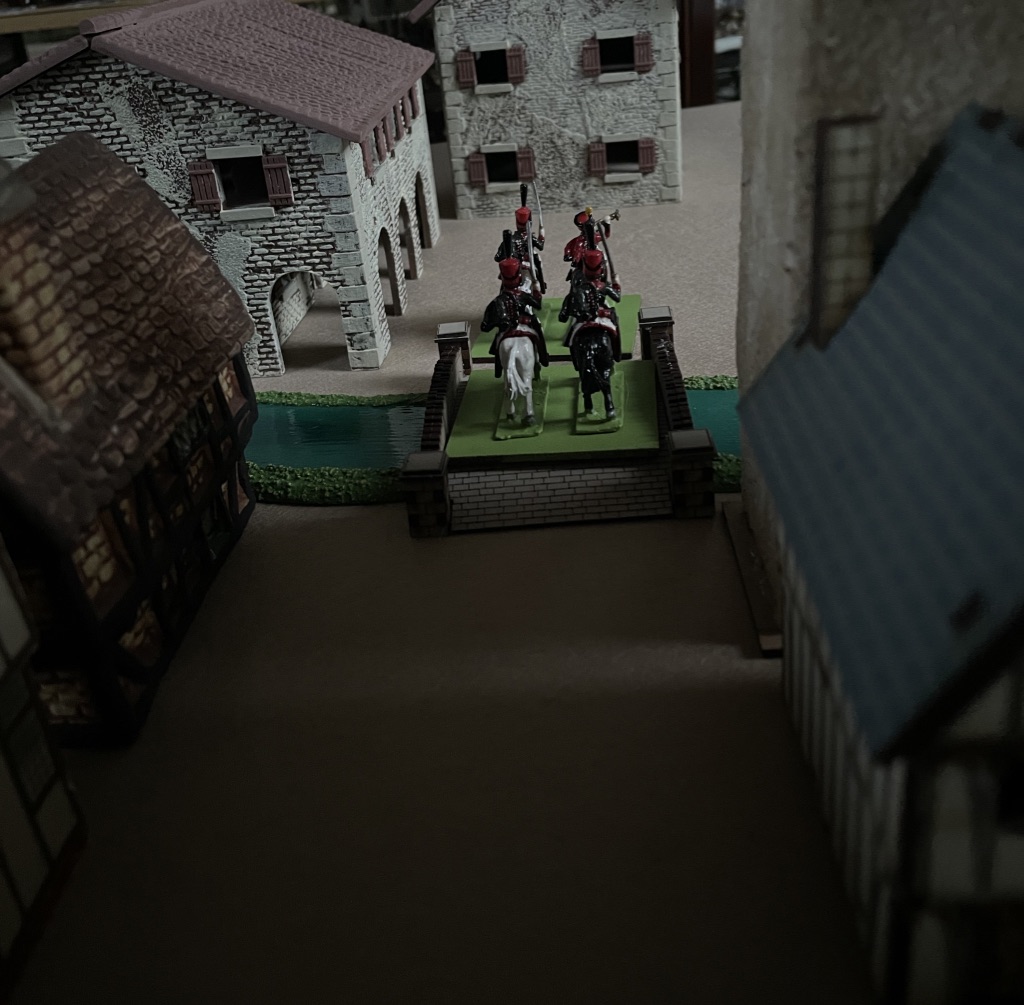
Forces were randomly assigned using playing card allocations along with a portion of blank entriesUnits deployed in contact and units were recognised as such at about 6 inches – the card only turned on a 2-6 D6. Here the right hand Piedmontese were certain nothing was in front of them – a heart was a dummy card while the left hand unit was not so sure so hesitated (on a d1) with no card turn. The right hand units poured forward towards the “old millhouse” spotting some real Austrian defendersThe lefthand Piedmontese units were suddenly exposed to Austrian infantry fire from a slightly sunken roadon the east side of the main road two piedmontese artillery batteries dropped into action again to be surprised by enemy troops in a slightly sunken and walled road. These were riflemen and on good form – one battery was quickly silencedHowever infantry units (white coated British Legion 1860) quickly drove them awayfierce fire was exchanged between the Bersaglieri and Austrians in the sunken road while Garibaldeans stormed the defended houses at the entrance to the townOn the east side 1859 Piedmontese infantry stormed the defended housesElsewhere Piedmontese forces had pushed on meeting little resistance (= dummy cards) to their front. A lone Austrian Artillery battery on the west side of town faces artillery and some more Bersaglieri Stubborn resistance at the Old Millhouse Finally the sunken road defenders are driven offAnd the west side Austrian defenders give up rather too quicklyexchange of fire results in another Austrian lossEven as west side Austrian defenders gather but………The Piedmontese quickly move towards their target – the river crossing. Another Artillery Battery blocks their wayOn the west side the Austrian defenders put up a good defence and with support nearby………The defended houses at the north end of town finally are overrunThe mill house and its defenders are abandoned by the Austrians who can retreatAustrian artillerists put up a stern defenceCrunch time at the town square as the Austrians are hemmed inThe Bersaglieri try to rush the ArtilleryThe Town centre defence collapses The Bersaglieri inexplicably turned tail on the west side while Lancers arrive to their rear. The British Legion finish off the town centre defenders on the left pictureThe Artillery of Piedmont watch as the last Austrian defenders in the town square are defeatedThe defended westside town square buildings are assaultedin a last desparate throw Austrian Hussars ride up the main street to halt the Piedmontese tide.The Hussars beat off the Lancers but to their rear the Artillerists are finally beaten while the East side is alive with Piedmontese. Everywhere Austrian defenders have melted away into the fields or across the bridge.The Hussars beat a retreat across the bridge bringing to an end the defence of the bridgePiedmontese Lancers cautiously follow.
The defended buildings were randomly determined and contained one unit each – no other benefits were given the building defenders. So they simply were a delaying factor assisting the mobile defenders fighting outside.
The scenario I played used a 25 step countdown and 1xd6 reduction per turn. The Austrians had to retire at countdown 16 from the edge of town, 7 – the town square and at 0 abandon the north river bank. Victory to Piedmont required they took the bridge before the countdown reached 0.
The game turns 1 to 3 were spent on the edge of town, then turns 4, 5 and 6 fighting over the town square. Turn 7 forced the Austrians back to the north bank but here ended the action as the Austrians actually ran out of defenders.
So the victorious Piedmontese captured the bridge intact and within the timescale set. There were no Austrian Engineers with a lit fuse to spoil their day! Anyway the Austrians would be back soon enough they thought…. Do I hear a Radetzky March in the distance?
For a very old ruleset Joe Morschauser’s rules played easy as I guess you would expect. With the tweaks to aid solo play they actually played very well.
I had bought the rule book for the Grid rules both the originals and Bob Cordery’s modernised version – Bob co edited the book with John Curry.
So this was a pleasant surprise to find a very playable set of “measurement based” rules into the bargain.
One scene – two battles – thats efficiency for you.
Monochrome provides a unity of its ownBut our world loves colour – sort of – the unity is lostWith my regular “What a Tanker” opponent I took the allies and a makeshift bunch of tanks – churchill, stuart, grant and a “shy” firefly Surprise surprise the german mechanics and fuel operators were on top gear – out come a tiger, a panther and a sturdy PzIV – needless to say flashy turrets were also on display. Its a pity there is not a special rule in WAT for complicated tech risk due to supply and logistics problems….. but this is just a table game like monopoly.We took the long table set up with tank groups arriving in diagonally opposite corners – here the germans creep into the centrerather brazenly the churchill and firefly just drive up the main streetThe weaker allied tanks stayed out of townThe churchill caught a sight of movement – fired and took out some buildingsThe stuart caught the PzIV in its sights and firedDespite hugging the old mill house the the stuart was spotted by the panther but no fire………The king tiger broke ground and took the Churchill head on……..And it was all over in a tick.The firefly got a line on the King tiger The stuart was now being targetted by both the Panther and PzIV – no one was getting any hits on anything except a barn doorFinally some allied success – the Grant crept up on the King Tiger – in my last WAT game post the Grant had been the “dark scary dog” for the big german cats.not this time – those roller bearings and cogs? (Frank Tank Rants has fantastic tank tech data to keep you happy for hours) were well oiled as the Grant failed to fire……Another allied tank gone Meanwhile the Stuart was holding its own against the “B” team of the Panther and PzIV. The problem was the Stuart was hitting its target without any impactIf that was not enough the big tiger with two kills already turned up Retreating – the stuart almost escaped before a fatal shot landed.The Firefly finally put in an appearance but was nochantly disposed of by the king tigerThe Firefly was last allied tank standing – game over. This one was quite quick which was useful as my regular opponent does not get much game time. That is why WAT is an excellent pick up game. Also I had time and the idea to get almost all my model buildings on the table.The buildings are a right old mix – some date from the 1970’s complete with enamel paint through decades old paper buildings where the damage is due to little insects! when in storage – ok the steeple was down to straight crushing. and some are ceramics from germanyThe next battle involved Austrians and Piedmontese/French so I got good use from the temporary set up.
A constant theme of my interest in art is the variety of techniques on show.
My Weekend Open Studios visits prompted me to dig out some wooden offcuts I had minded to fashion into buildings.
The idea for “woodtown” was to provide my grid gaming with appropriately sized buildings. And they would be in keeping with the abstract nature of grid boards. In terms of the art they are definitely inclined towards Paul Nash. Ferens Art Gallery can be found in Kingston Upon Hull and an interesting painting by Paul Nash can be seen there.
Paul Nash – East Coast Portsome old bits of 2×1 with 45 degree cuts to create the roofline – at various heights to emphasise the randomness of old italian hill towns. The wood grain helps deflect thoughts that these are just bits of wood.The two clusters – the rough wood finish works on the red roof while the uneven whitewash fits the style
They make their first contribution in my recent Neil Thomas 1864 Minigame. Ironic that the game did not use grids…………




 The Wargaming Erratic