So unexpectedly I had a scenery moment (or maybe a senior moment?). I had just invested in some stone walls even though I had intended to make my own.
And then I considered that I simply had no hedges. None – as an Ancients/Medieval come Early Modern gamer you only need them to hide ECW dragoons at Naseby I think……
Well as much as I like Last Valley and other off the shelf hedgerows I suddenly remembered a recent acquistion – Operation Warboard. In it Gavin and Bernard Lyall give you a lot of info on fighting WW2 battles and also putting together the game as a whole. No time to waste on scenery though – just a stick with some chopped washing up sponge does for trees.
So I thought as part of my Operation Highstreet I might try some homemade hedges. What did I have to lose.
I then did nothing. And then on a quick whizz through a corner shop I spotted a pack of 10 sponges for 100p or 10p each. Job done.
Some crude carving which looked significant until it all got covered in tea………….
As it happens I have also been collecting tea – yes tea in tea bags. Now this particular minimalist technique I have not used since as a kid I used dried tea to save money for buying figures. I still have some D&D and Vikings figures with dried tea coated bases – imaginatively coloured brown tea colour – talk about tight fisted on spending!
Well this time I was pushing the boat out – no brown winter hedgerow here. It would be spring green this time.
Each sponge yielded two modular hedges – I reasoned this flexibility would help give variety.
lots of tea loss did not happen – so that was good – the double PVA coating worked a treat
I gave each a double dose of PVA glue – the first to fill up airgaps and the second to take the dried tea which I just rolled the sponges in, pressing carefully.
blueish green to give some depthchristmas green because its seasonalbright highlights just a bit too bright so I finished them with a very small dry brush of VJ Game Colour – Goblin Green. I actually gave this first one a second middle coat and on all the others put more paint on the middle coat stage. That said it would be correct for an early spring deciduous hedge just sprouting leaves………
The dry brush of three coats going from blue green to a more yellow green worked for me. At every stage I let things dry out completely so not much time in each stage but the stages were spread out over a week.
And that is it. Very very quick if a bit brutal but in the spirit of Operation Warboard.
Now they just need to find a table top battle………………
My current preoccupation with 20th century warfare has scooped up two random purchases that were “I might read that one day” plus a rebuy for the third time – this time I read it cover to cover!
How ironic to run a cover with a Valentine in Axis colours – is this a metaphor for “North Africa West – confusion”?Plain by but no means less interestingIt might have been so different
“The Murder of Admiral Darlan” does not leap into most peoples mind as a book worthy of a second look unless maybe it was a Napoleonic era study. Quite simply Admiral Darlan led on the wrong side for too long before switching sides only to be murdered. So no need to read the book then. Wait – it is written by an american and is not really about the murder at all. It details just how close the allies came to mess up Operation Torch before they landed! And there is still plenty of action. If you want ideas for gaming its worth a look.
The General de Gaulle memoirs were published by Collins in London in 1955 the year after Dien Bien Phu (1954) definitively signalled the end of French Indochina. The first part 1940-42 is all about defeat and survival. And de Gaulle emphasises the Empire as his sustaining source in a way english speakers might not appreciate, not least as the British Empire had its own story to wrestle with. The brief Northern France actions and the sheer chaos of an uncertain France as belief fell away offers yet more ideas for the wargamer. I still think a country defeated in 1815, conquered in 1870 and nearly overrun again in 1914 and finally part annexed by its neighbour in 1940 always has an interesting story to tell.
Charles Whiting has been a prolific author of war stories. Many are written under nom de plumes such was his rate of production.
His book about Operation Torch feels different to the other two books. He was not there but he went to war at 16 (illegally) and marched across northern europe in an armoured reconnaissance unit ending up in Germany. So I think you can say his writing is very observational with concern for the moment. Perhaps though you can match that in de Gaulle when he talks about french tank attacks in northern France and Tompkins relaying details of the “uprising which failed”.
As a trilogy these three books are complimentary and work. In my view you read de Gaulle and get suitably downhearted and deeply suspicious of everything Vichy as well as Britain and the USA! There is some action but mostly positioning. Then you read Peter Tompkins and the upbeat Americans just about holding together the idea they should be in Europe via North Africa and that Vichy could still be a good angle: More action and some spectacular moments not least in Algiers. Finally the action really kicks off with Whiting and ends with Von Arnim, Rommel followed by Montgomery and Kesselring all pitching up in Tunisia with an already frustrated Patton, Clark, Fredenhall and of course Eisenhower. Even Alexander gets a look in.
The 1942/43 battles involved German, Italian, Vichy, Free French, US and British Empire and Home forces on land, at sea and in the air. With lots of confusion, poor weather and both out of date and brand new technology these stories lack for nothing.
The three books cover the period well, in a way I don’t think any one book can.
De Gaulle starts us off in 1940 and provides the approach including some useful Africa maps to show context – North Africa was not simply below Spain and Italy.
Then Admiral Darlan fleshes out the North African situation and the US interest building to the uprising and invasion events in detail. The murder provides the context.
Finally kasserine provides in effect what follows and how armies of five major countries and their allies end up facing off in hills west of Tunis.
In each case the overlapping narratives compliment each taking different lines amongst the same information. That means repetition is not noticeable.
Oh I did not mention on Kasserine Pass – the first moment in WW2 the US troops went head to head with the Germans and came up short.
So if you want a diversion from the perrenial Normandy Landings, El Alamein, Stalingrad or indeed Blitzkrieg then read these three books and get caught up in a veritable confusion of events and participants!
I have restarted my WW2 era interests through painting some of the Plastic Soldier Companies 1/72 figures. I have painted Russian and US troops so far. As my interests are solo and mythical, matching historic countries and or uniforms is not essential.
If I ever play a live opponent, I will probably be ok as there seems no shortage of modelled german armies……..
Having painted these figures I do like some poses a lot while others seem a bit odd. The Russian hand grenade thrower and SMG handler makes sense if you stand him against a wall though. So I think PSC did a good job here. The US set has some excellent “moving forward” troops, yet too many kneelers?
In production. I opted to paint on sprue and then cut them off afterwards – only a few needed a touch up where there was no base connection. I did think handling would slow me down but on balance I would say there was no loss of overall painting speedSome useful box art for the painter – not always the case. Indeed I can only show you a plastic bag for the US troops.I quite liked the suggested paint guide. I opted for a brighter uniform which was toned down with a wash.some of the figures had a black undercoat and weak yellow ochre block paint
I opted for block painting with a wash. I used a proprietary matt varnish which worked in the odd place but generally came out satin: Answers on a postcard.
animation is measured. I think the figures improved with paintingNo shortage of OfficersI thought these figures were very goodThe figures to the front are black undercoat while to the rear are some who were white undercoated. Otherwise they all finished with a wash and matt varnish.
I had some fun picking the shade in the end opting for “seraphim sepia” on everything except the odd helmet
I toyed with three man square bases as per Peter Pig then remembered I had decided to use individual circles – the vintage 1p piece is just right for me, 5p too small and 2p and 10p too big.
In my last post I described a small action in a narrative style.
I created the Scenario to try out some new figures. As I have no heavy weapons the challenge needed to be simple.
One box of Russian Summer dress Plastics Soldier Company 1/72 infantry plus one box of Early War US 1/72 infantry. Sadly the heavy weapons for the US figures get a very negative review on Plastic Soldier Review and from the photos I was inconvinced as well. It seems though that the Russians in all respects are dealt with better by PSC.
Also I game solo or rather ZERO. So the scenario had to meet certain specifics. The main one was that surprise or chance was needed to animate the game.
Most solo players are more than happy with rulesets that randomise outcomes far more than the norm for two player games. The reason is easy to see – deprived of your human opponent you need to substitute what would have been their random or unknown acts.
The following Scenario details will help you to apply this to your chosen rules and any number of players you chose.
RED v BLUE – for convenience I have used these terms. In the narrative the Azorians were RED and the Vossackians were BLUE.
RED objective: Place observer on hill to view valley below and call in an air strike against expected enemy concentrations.
BLUE objective: defender may or may not appear!
You can see immediately I have made this one sided in the sense that RED is the active party and BLUE the reactive party – well initially.
An abstraction of a Platoon – using 3 figures per section. Platoon leader has two rifleman. The observer team brought their own section with them. BAR’s and Garands are modelled by PSC. In the scenario Grabern split one section amongst his other three.
notable rules:
you should specify a distance for sighting or observing enemy units. This might look odd on the table when you can plainly see opponents in direct sight. This abstraction is fine – no different to the out of scale scenery versus figures or weapon ranges v movement. Distortion is the whole point of table top wargaming.
The defender throws each turn after RED has moved to find out if a part of its force has appeared
defenders appear at certain points (marked 1 to 8 on the map)
if RED pass through a marked point it ceases to be a point of entry for BLUE
to add variety troops can be of different qualities
movement was not hampered by the hills
movement was hampered by the woodland which covered all the hills anyway
I thought about which rules to use. Having returned only recently to the WW2 era I had previous rulesets to draw upon as well as new ones as yet untried.
Poor Bloody Infantry by Peter Pig
Chain of Command by TooFatLardies
One Hour Wargames by Neil Thomas
Various Featherstone rules – notably the set from Battles with Model Soldiers
“Battle” practical wargaming by Charles Grant Senior
“Operation Warboard” by Gavin and Bernard Lyall
Rapid Fire reloaded
played these and enjoyed them quite a few years agostruggled to get into these rules despite liking TFL mechanisms/ideas the go to ruleset – great for timepoor moments and even brain tired ones as well. A great antidote for “i am too busy to game”. They look like Vossackians to me…….and maybe both 28 and 25mm chaps on show – to be honest I had never noticed before?A Classic ruleset (almost) – my first “bought” book – the “incomplete” ww2 rules were a fantastic technique of Donald Featherstone’s, to make you do some work yourself – definitely a Classic in that respect. Could you get away with half a product today?discovered in a charity shop in Autumn 2021 – this book started a minor project and buying those Plastic Soldier Company figures, who fought this first WW2 wargame in many a long year!In for a penny, in for a pound – having found the Grant book by accident I remembered an enticing blog post about “Warboard” being an often overlooked classic but more to the point definitely not typical. I have read it cover to cover – fascinating.Just out in this format – Rapid Fire is now a veteran set – and with these quick play rules I will look again. Many years ago I dumped these in favour of Peter Pig before abandoning WW2 completely. Yes I have rebought Peter Pig PBI albeit secondhand.
To confound matters I remembered Neil Thomas published Wargaming an Introduction (WaI) that had a WW2 ruleset.
I cannot quite explain this – but I chose to run out these WW2 rules first. Well maybe I wanted a One Hour Wargames “feeling” with more detail?
I opted for this ruleset feeling that One Hour Wargames might be too “lite” for my needs.
WaI is maybe not familiar to many people. It has similar mechanisms to other rulesets.
Dice were always six sided except a 1d8 for defender unit location
Back to the Scenario the following were added to the rules
I permitted double moves at the start as my 6×4 or 1.8m x 1.2m table had a lot of distance to be covered for no response due to the sighting rules.
Essentially the units could sprint (double move) once followed by a minimum two moves at normal speed.
Sections comprised separate figures spaced up to 3cm apart
3 Sections equalled a Platoon
I diced for observation distance on the day
20cm on a 3
30cm on a 4
40cm on a 5
50cm on a 6
After each RED move BLUE threw 1d6 to appear
1= throw a 1d8 for location of defender appearing
throw 1d6 again to find out whats there
1 nothing ! (this is logical confusion when solo gaming)
2,3,4 means a rifle section
5 means SMG section (could be another rifle section of course)
6 means LMG or on a second check =6 again you get (1,2,3 HMG or 4,5,6 Heavy Mortar). In my game these would never have actually appeared – simply their effect being used.
I also tested units for grade/quality as WaI requires this info.
1,2 2nd rate
3,4,5 average
6 elite
What Happened?
Lieutenant Grabern set off with his platoon and the observer team. The game lasted 17 turns including some double moves at the beginning. That also meant RED closed at a faster rate per BLUE chance of generating defenders.
On turn 2 a defender location (3) was generated but at this stage its type was not diced for
On turn 7 another location generated (5)
Location 1 was overrun early on so could never activate any defenders
On turn 8 location 4 was also neutralised by RED
Location (6) generated on move 9 along with (2)
On move 11 location (3) was discovered to be an LMG and an elite unit into the bargain. They quickly pinned White Section.
(5) produced elite riflemen and (2) became another LMG – also elite!!!!
Donovan wiped out the LMG at (3) on move 12.
But this was soon replaced by an average rifle section (6) generation
The Azorians were all average troops and once effectively surrounded started to withdraw from move 13 onwards. On move 15 White Section was destroyed while on move 16 the Platoon Leader (Grabern) Section was nearly wiped retreating to the enclosure.
The difference in the “Observers” moves forward and then back is due to the action ending for the Azorians at the enclosure and not behind Hill 90 which was still several moves away.
So there you have it. A simple scenario for a platoon type action.
I was surprised and pleased at the fun levels without heavy weapons or any armour present. They can wait their turn.
Finally the satisfaction is also in selecting, acquiring, painting and then gaming the figures.
Lieutenant Kuznets replayed his orders – ascend the valley side to the small wooded hill south west of the 3rd companies position, securing it and then reporting on any activity observed to the west.
Hill 91 was more than wooded – there was “fight” in it. Lieutenant Kuznets cursed – ripe for ambush.
It seems there was concern about the presence of the enemy. So far the loose talk was that the Azorians were to the south east, so who or what else could be to the west? Rugians?
Meanwhile Lieutenant Grabern looked at his watch, then the sky and finally signalled Sergeant White forward. Grabern thought about his objective – escort the observer to hill 91, wait and protect him/them until they pull out.
The climb to hill 90 was far too wooded for Lieutenant Grabern’s taste. Ambush country….
Straightforward orders though. The whispers were that the enemy were in the valley beyond and that the hill was probably occupied already. It felt like trouble.
Grabern did not like the open ground east beyond Hill 90 – the most direct route to Hill 91.Grabern having crested hill 90 directs his platoon south east to the building enclosure – here was some cover he could useSergeant White secured the buildings and then followed by Sergeant Donovan pushed onDonovan’s Section held the enclosureAll was quiet and Grabern did not like it – the mist was not lifting which was good and bad – bad not least because the observer would have little to see – surely this mission would be a waste of time!The observer team moved through the enclosure. Sergeant Bird looked at the sky or rather the mist – this was going to be a pointless task. But orders are orders and he needed to look into that valley.White was now on top of Hill 91 and the valley drop would begin soonSergeant Bird had crested Hill 91 and without any trouble. Maybe this would be a quiet day all round after all? Sergeant Donovan circled round to the left of Whites section moving on the clearing near the very hill top. White then moved through a copse to the open clearing and some swampy ground……….Too late White saw some furtive movement ahead, followed by a harsh sound of a machine gun opening up. Damn, the Vossackians really were here already………An LMG team of Kuznets platoon commenced firing on the advancing AzoriansHaving broken cover by the clearing both Donovan’s and White’s sections were an easy target. They returned fire as best they could but the target was difficult. At least there was only one of them……..To their right the Azorians now received new fire from another Vossackian fire team. Donovan’s Section finished off the Vossackian LMG to their front.To compound matters another LMG opened up to the north – this time on Sergeant Bird himself. Runners were everywhere as Bird told Grabern, Donovan and White he was pulling out. White and Donovan were already locked in an unequal firefightGrabern had just arrived on the hill 91 and quickly agreed with Bird that withdrawl was in order – the mission was now pointless as the fire fight heated upHis own section immediately took casualties from LMG fireWhite was losing men fast as wellWhite and Donovan’s sections withdrew, firing as they wentThe Vossackians now moved into the clearing to get better fire positions but they also took casualtiesThe Vossackian southern fire team took casualties as well………..Reluctantly Grabern pulled back to cover the observer team and get relief from the Vossackian LMG to the north. In the copse by the clearing White and Donovan were only slowly withdrawing. Grabern wanted them out faster.It was then apparent that the remnants of White and Donovan’s sections were being overwhelmed.The observer team had now retired to the enclosure closely followed by some of Grabern’s section sent to hold the enclosure itself. Grabern stayed on the edge of the woodland to give what cover he could to what was left of White and Donovan’s sectionsThen as Grabern made it to the enclosure White and Donovan’s survivors broke clear of the woodland and retreated across the open ground for the safety of the enclosure.Now though, the Vossackian firing died away – fortunately the Vossackians either lacked confidence in numbers, were wary of getting caught in the open themselves or had orders simply to hold the hill.
Lieutenant Grabern continued his retreat back to Hill 90 protecting his charge – the Observer. His platoon had suffered many casualties yet performed well under fire.
Later Lieutenant Kuznets crept amongst his men praising them and checking their condition. He was still wary of what the Azorian intentions were. He had already sent back a runner to report his success at clearing Hill 91. Also he had seen firsthand that these Azorians were well armed and disciplined under fire. Unlike in some of their previous encounters.
Fauxterre 1930+ Rugia is wracked by civil war and Azoria and Vossakia cannot resist getting involved. Their forces initially support the Rugian factions before eventually colliding and then embarking on an unofficial war of their own!
Neither Vossakia or Azoria want to annexe Rugia yet they want to influence the area which is rich in resources. Both sides treat the conflict as a sideshow with consequences for logistics, resources and planning.
Published by Cassell in 2000, War at Sea in the Ironclad Age is one of those hardback books full of colour plates.
That might imply that it is a lightweight – “coffee table” book. For a landlubber like me it was an excellent introduction into a period of history I have had little interest in before.
Roughly covering 1850 to 1900 it charts the development of the Ironclad – the transition from wooden sailing ships to the 20th century “Dreadnaught”.
My initial interest was through this years main project – The Wars of Italian Unification eventually concluded in 1870 during the Franco-Prussian war. Before that the Austrians and Italians had already fought one significant naval action in the Adriatic, the battle of Lissa in 1866. It was notable for poor management and control rather than any technology on show.
The book covers several key actions over the 50 year period using clear and helpful diagrams
At the battle of Lissa the Italians had the only “turret” ship present, in the brand new British built “Affondatore” that also had an enormous front ram hull design.
The Italian “Affondatore” (roughly meaning the “sinker”) when presented with an opportunity to ram the Austrian “Kaiser” failed to do so. The Austrian Flagship “Ferdinand Max” rammed the “Re d’Italia” sinking her immediately (technically the Italian flagship, although the Admiral had already decamped to the “Affondatore”).
The period saw technology rapidly change – submarines, torpedoes and heavy guns in revolving turrets all made their appearance. The American Civil War showed off the sleek “Monitors” of inshore/river warfare.
Lots to consider and what I found helpful was that the book is full of useful information tightly presented – even if often repeated in different ways. This helped and the use of coloured maps with 3D ships showing phases of key actions also helped in my understanding.
The Author Richard Hill – a retired Rear Admiral – addressed a new period for himself as well, thanking John Keegan the series editor for the opportunity. Just maybe the freshness of the words, to me, reflect his new enthusiasm for this period in history.
I obtained the book from Dave Lanchester, who suggested it, when I was seeking a book about mid 19th century european naval warfare.
Dave has no website but is easily contacted – details below.
Myton, Wyke and then Kingston upon Hull to give it its proper name has always looked to the sea and has many connections with northern Europe, notably Scandanavia, the Baltic and the Netherlands or Low Countries.
The River Hull came to prominence in the 12th century when the Cistercian monks of Meaux (near Beverley) exported their wool to Europe and developed the river entrance into a thriving port leading to the creation of the hamlet of Wyke. Wyke is variously described as being a settlement – the word “wic” being a common term although some say it comes from scandanavian meaning creek or small river.
Victorian Arcades can still be discovered with artisan shopsCity Hall and theatre harks back to a time when Hull enjoyed much prosperity
By the end of the 13th century King Edward I granted Wyke its first charter and it became known as Kings Town on the River Hull or Kingston upon Hull.
in 2022 the Maritime Museum reopens after several years of renovationOptimistic Hotels from a bygone erawhen public houses were everywhereimposing buildings remain despite Hull being the most bombed city during World War 2 and then decades of constant demolition and redevelopment the old town down by the river Hull still has some impressive buildings where renovation has given them another lifeAnd yes there still public houses dotted aroundThe river Hull defines the reused Old town on its west bank while the east bank is still largely a different industrial legacyElegant arcades still existwith some very fascinating shops!Trinity Market has been renovated and rejuvenated with plenty of small enterprisesand there are people still remembered through the odd statue such as Amy JohnsonThe Deep Aquarium is a big draw for the cityWith a fabulous central tank holding many species it really is worth a visiteel with attitude!plenty of bright fish to be seenNearby you can find eateries next to the marinaand boats are still to be foundThis shark statue at the Deep with the River Hull flood barrier behind – signs of our timesThe Deep Aquarium is a magnificent site located at the confluence of Hull and Humber
Today Hull, as it is commonly known, is a post industrial city which usually means tourists avoid such places. Hull is rich in history and has some excellent locations to visit. So make 2022 the year you visit.
Arnald, George; Charles I Demanding Entrance at the Beverley Gate, Hull, 23 April 1642; Ferens Art Gallery; http://www.artuk.org/artworks/charles-i-demanding-entrance-at-the-beverley-gate-hull-23-april-1642-78270
Kingston upon Hull was the place where the real spark of a rebellion occurred. the English Civil War has many claimants to its origins. From Parliamentarians to Scottish religious covenantors the subsequent victory had like success many parents. Failure is invariably an orphan.
Nowadays the differing claims are somewhat muted through 300 years of reconstituted monarchy.
So we should not underestimate the risk a certain Sir John Hotham took. Twice he refused King Charles access to the vital weapons arsenal held within the walls of Kingston upon Hull.
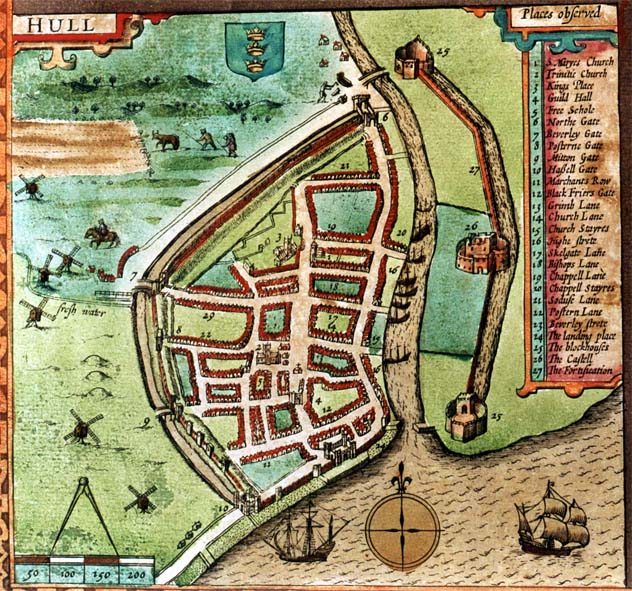
On the map the gate No7 was the Beverley Gate where King Charles I was denied entry and whose foundations are preserved today. The foundations now lying below current street level were given a new surround and saved for the City as part of the 2017 cultural celebrations.
In 2017 they were not quite ready for the public – today you can descend to the original gate level and see them as King Charles would have done!
Hull as it is known today is interesting not just because of its white telephone boxes and the Amy Johnson statue!
It is not regarded as a classic city of the north like York or Chester, yet it is full of history.
In 2017 the city enjoyed UK city of culture status and this gave it a big lift in terms of arts and culture – like so many places Covid19 has dented the benefits.
I have previously blogged about the Narwhals tusk……………now departed to the north sea
Do not be deterred – go and see Hull and visit that gate where history was made.
William of Orange one of our influential British Monarchs has an equestrain statue in Kingston upon Hull on the edge of the Old Town.The River Hull empties into the broad Humber Estuary some 25 miles from the north seaArnald, George; Charles I Demanding Entrance at the Beverley Gate, Hull, 23 April 1642; Ferens Art Gallery; http://www.artuk.org/artworks/charles-i-demanding-entrance-at-the-beverley-gate-hull-23-april-1642-78270
I wonder what would have happened had Charles secured Hull?
With summer now a distant memory, here is a reminder of sunny days in 2021.
looking towards the mouth of the Tamar where Devon and Cornwall meetThe marina the old harbour at the very mouth of the Tamar on the Cornwall side is Kingsandview from the heights above KIngsand Nearby Cawsand, just a short walk from Kingsand, is where the Plymouth ferry beachesEarly morning sun over CawsandThe Plymouth ferry arrives at Cawsandand beaches as the commuter queue forms!simple boarding technique means sometimes the ferry can’t run if this operation cannot be doneonce aboard its all engines reverse and the vessel eases off the shingle


 The Wargaming Erratic