Some more castles and fortresses as the Basque Tour went to the east coast and Barcelona. This time the theme is Rennaissance and Early Modern Warfare with structural reactions to the development of gunpowder………


Some more castles and fortresses as the Basque Tour went to the east coast and Barcelona. This time the theme is Rennaissance and Early Modern Warfare with structural reactions to the development of gunpowder………

Wargames in Print has been on a rocky road – I was a subscriber to Battlegames (BG) not long after I found it by chance on a WHSmith railway station stall back in 2008. I abandoned that journey when it really disappeared into Miniature Wargames (MW). MW had always been a mixed blessing for me while Wargames Illustrated (WI) had been a favorite before leaving the hobby.
Henry Hyde and BG brought me back into the hobby. And I returned to the Wargames Publication world transformed by the Internet with Blogging/Being online all the rage.
I started reading blogs about 2011 and the print market now seemed terminal although BG helped sustain my interest. WSS I luckily discovered at another WHSmith when that shops footfall was in serious decline.
Today I am fully erratic! If I buy at all, it is mainly WSS but occasionally WI and MW.
This month both MW and WSS caught my eye (last month it was WI425 and what a cowboy).

The WSS focus was Hundred Years War and although at the wrong end of the war for my latest interest I decided to take a punt. I enjoyed it and I liked the range of scenarios/actions.
The Slap Chop/Grisaille method painting article was a bonus. I have read quite a few online articles on this subject yet some printed paper words and pictures were still enticing. That is the “print preference” still in me. I could contrast it (sorry) with the Speedpaint article in WI425, but I won’t, it was another very effective print article on a subject I have read round on the internet.
Now MW484. The last word was by Brenden Wheatley who talked about the importance of the Solo Wargamers Association and solo wargaming that sustained his hobby which he now pursues in both Budapest (see some hussars and music at the end of this post in Budapest) and Brecon!
Mid 19th Century warfare was a topic in WI425 – Perry French Franco Prussian War (FPW) plastics painting class while MW484 led with the Schlieswig Holstein Question.
Dave Tuck gave an excellent taster for the two wars – 1st and 2nd (1848 and 1864 respectively). Given MW style and content he did the subject justice and I would definitely recommend it to anyone wanting a clear straighforward way into the subject.
FREE RULES – Dave Tuck offers his ruleset via a link on the MW web page. FREE WARGAME RULES
Interestingly Dave Tuck started his journey before the FPW range from Perrys appeared and after the Helion range had ceased production. He had also used the North Star range. For coverage of the second war (1864) the one he opted to develop, he also resorted to conversions.
And I do think you should not be put off by the lack of a “go to” range. in 28mm 1864 can draw on Perrys FPW and any number of ACW ranges as well as other mid century wars in the Americas as well as the Crimean war of 1854.
If you are a uniform purist then that lack of exact replicas will probably drive you mad!
For the 1st war in 28mm, if you want to literally start at the beginning you can steal lots of Napoleonic era forces. 1815 to 1848 saw new uniform ideas but a lot of conservatism while weapons technology appeared to have stalled. A few months into the 1849/50 war and its all changing with kepis and pickelhaubes gathering pace alongside frockcoats, breechloaders, rifling and even the very early machine gun. Given quartermasters stores and regulations were never up to the minute, you can have lots of leeway in my view. You can borrow both back, forward and sideways for these wars!
I have grown to like the 1st Schlieswig Holstein war period simply because I get the best of both worlds – with the early versions of FPW uniforms and weapons still mixed up with Napoleonics. You have tailcoats, frockcoats, all types of shako, kepis, pickelhaubes, flat caps, smoothbores and rifled weapons in the mix plus of course emerging railways and telegraph.
If I was doing 28mm I would follow Dave Tucks approach and start with 1864 (the 2nd War) using FPW/ACW resources.
If your more Napoleonic in outlook opt for the 1848 or slightly earlier uniforms – the Danes are clearly still Napoleonic as are many German Confederation troops which just leaves the Prussians and Bavarians in their iconic pickelhaubes and combed helmets to be sourced from ACW/FPW era. And you don’t need fancy rifled/breechloading artillery yet – smooth bores will still work. You can also consider Crimea War for 1850’s era uniforms.
I would look at Ed M’s Wargames Meanderings for further inspiration if Dave Tuck’s article does not convince you.
I wanted as, with many of my projects, a low cost option. 1/72 plastics used to be low cost. Now they are no longer so cheap. Yet you can still pick up around 50 figures for £10. The key issue is sculpting quality, figure poses and paintability. You have to love the sculpts, I have grown to like their roughness in an age of 3D marketed perfection. To get the repetitous poses you may want you have to buy multiple boxes. My advice then is that if multiple poses is a problem go with 25/28mm sector metals. Finally paintability – the internet provides an astonishing window into the art of those who wash, prime and then successfully paint bendy plastics. My favorite site for inspiration is Pauls Bods – he can even make venerable airfix ranges look compelling. Also Philotep is worth a look. And you can always look at weather like Crimea, being winter wars there is a greatcoats crossover which can hide a multitude of things. Tumbling Dice Miniatures do ranges of 1/72 sculpts which are excellent – cast in pewter. I prefer the figures in summer gear with greatcoats packed away and blankets rolled. So Crimea ranges might also help here for those who want correct season clothing. Also Jacklex relaunched a few years ago in 20mm.
I opted for 20/25mm and have accepted a complete mash up of ranges both plastic and metal and the inevitable conversions.
20/25mm or 1/72 is small enough to hide the imperfections at 3 feet yet not so small that you can’t enjoy each figure in its own right. The scale remains my perfect compromise for the “table top” game.

I have bought from

Alas the sheer variety of infantry types has overun my imagination and SHQ remains a questionable (sorry again) project with slow yet very enjoyable progress! Most units and figures are stuck on the paint table because I keep being distracted by mechanised warfare, medievals, Sci-Fi and yes even some FPW french figures daliance – Emhar – You can’t keep a good kepi down.
Which brings me back to WSS125 again and the 100YW. I have succumbed to yet more diversity in my painting – digging out my various unpainted medieval figures. My aim had always been Italy for this period, but it seems alighting on the battle of Shrewsbury 1403 while reading a biography of Henry IV caused me to re-examine an english force.

Who can avoid Hotspur…..thin end of a new wedge?
It remains to be seen what progress I make. And of course the next butterfly moment armed with a chance magazine purchase is probably just round the corner………


The Second battle using my “Buildings Blast” set up saw a mid 19th century action with Austrians and Piedmontese in play. It was a solo play this time.
I used the rules published by John Curry and the “history of wargaming project” with some adaption for solo play.
Using Neil Thomas grading of troops I adjusted the firing and melee rules.
I also used the Roster system unaltered. Infantry got 4 circles and a cross while Artillery got just 2 circles in this game. Essentially in the basic game a hit meant a unit (= 1 base) was destroyed. Roster rules gave units/bases lives in the form of circles and crosses on the roster which you ticked off as they were lost.
The Scenario was that the Austrians were retreating and the force here was ordered to hold the bridge in the town. The crossing was one of only a few that allowed artillery and logistics easy crossing of the river. The Piedmontese advancing from the north west had orders to seize the bridge as quickly as possible.


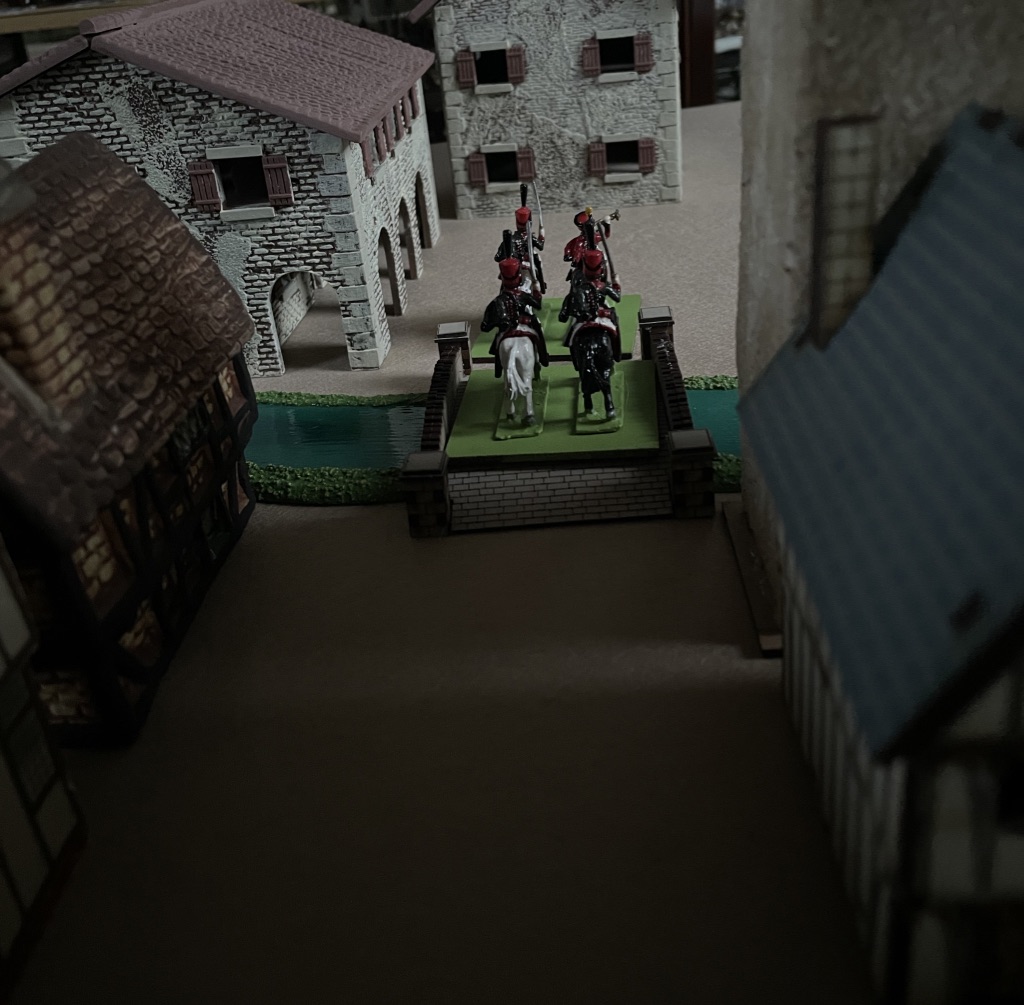

The defended buildings were randomly determined and contained one unit each – no other benefits were given the building defenders. So they simply were a delaying factor assisting the mobile defenders fighting outside.
The scenario I played used a 25 step countdown and 1xd6 reduction per turn. The Austrians had to retire at countdown 16 from the edge of town, 7 – the town square and at 0 abandon the north river bank. Victory to Piedmont required they took the bridge before the countdown reached 0.
The game turns 1 to 3 were spent on the edge of town, then turns 4, 5 and 6 fighting over the town square. Turn 7 forced the Austrians back to the north bank but here ended the action as the Austrians actually ran out of defenders.
So the victorious Piedmontese captured the bridge intact and within the timescale set. There were no Austrian Engineers with a lit fuse to spoil their day! Anyway the Austrians would be back soon enough they thought…. Do I hear a Radetzky March in the distance?
For a very old ruleset Joe Morschauser’s rules played easy as I guess you would expect. With the tweaks to aid solo play they actually played very well.
I had bought the rule book for the Grid rules both the originals and Bob Cordery’s modernised version – Bob co edited the book with John Curry.
So this was a pleasant surprise to find a very playable set of “measurement based” rules into the bargain.

I have slowly started to look at some grid gaming set ups. My starting point has been that they would aid campaigns and to that end allow quicker solo games. I opted for two 3’x2′ boards which could then give me a 4’x3′ table which also figures in Neil Thomas rulesets.

As a bit of a test I used a Neil Thomas scenario from the C19th European Wars book (NT19e) – the Cristinos v Carlists, in my case Piedmont squared up to Austria.

I use 40mm square bases for my 19th century games and I have chosen a 50mm grid – i.e. no perfect fit of base to grid square. And for this test I used essentially formations from Neil Thomas NT19e. The exception being that my square 40×40 basing really distorts the column or line option choice.


Up in the Lake District I encountered this very friendly robin near Ambleside.
One scene – two battles – thats efficiency for you.


r
r
r
r
r
r
r
r
r
r
r
r

A bit in arrears on cycling and to be honest a bit thin on castles too.
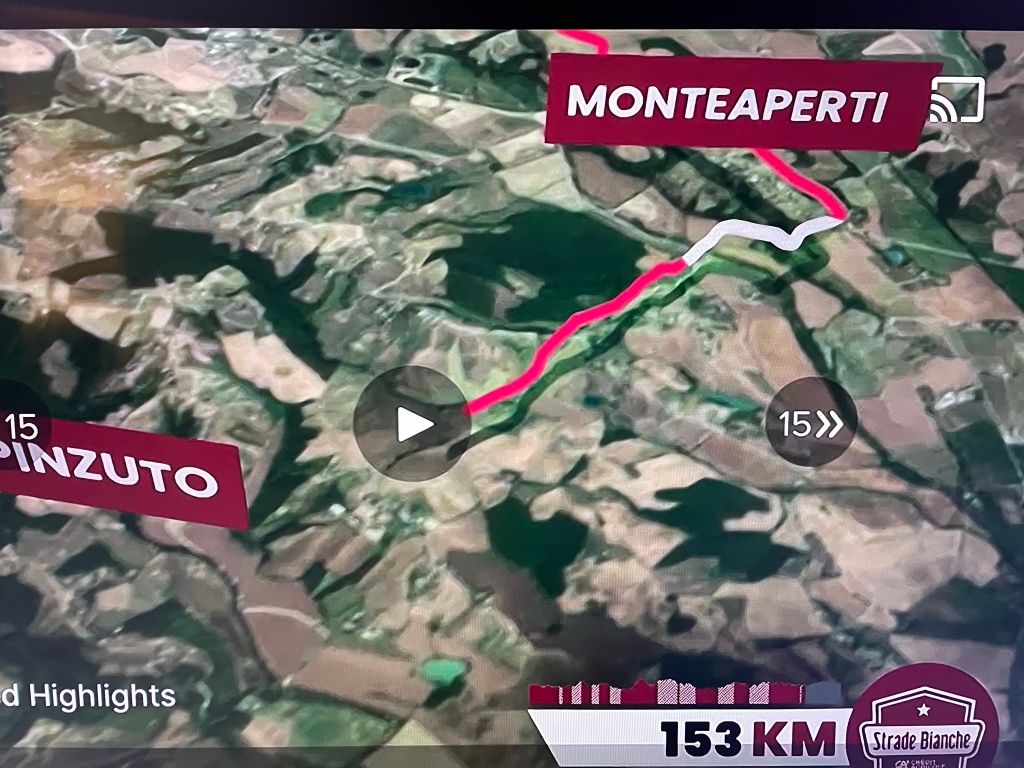
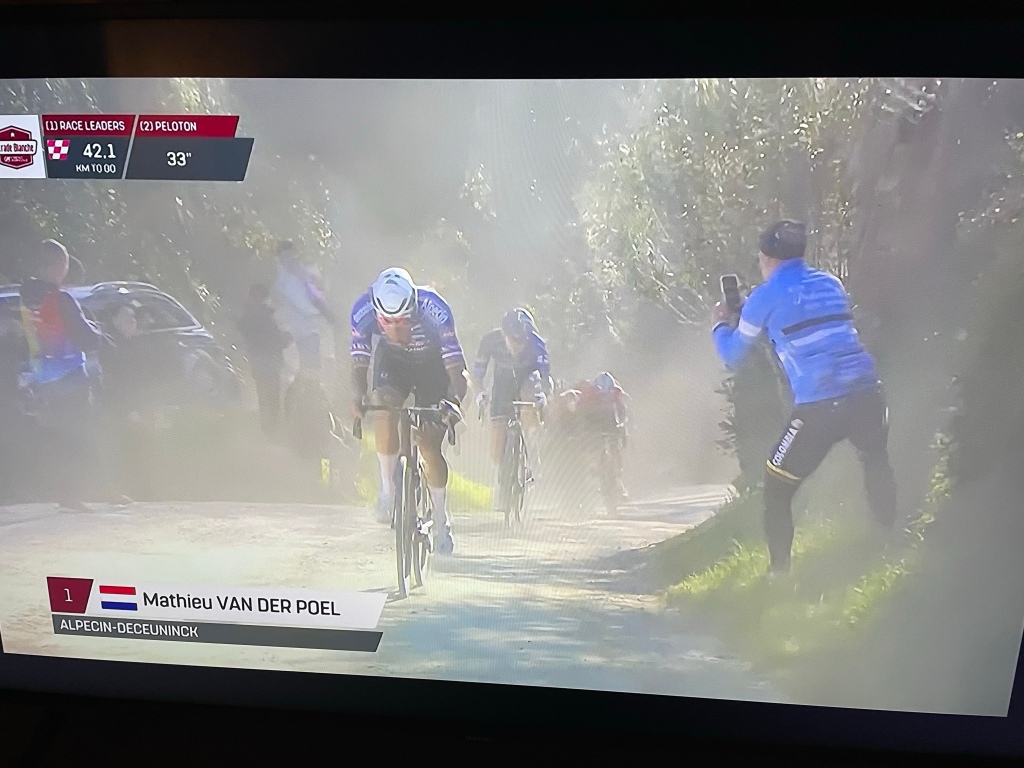
Best I can offer was monteperti featured in the strada bianchi circuit this year


Here is some coronation day music on armed forces day – a time to reflect on those that defend our greater liberty and freedoms.

Nature has a way of making even colour it’s own magic


Every year I get a smattering of castles in my house courtesy of GCN+ and pro cycling coverage of racing.
With helicopter views of the peleton weaving its way through the land the cameramen get bored and snap the odd castle.
These castles to my mind look different to those I visit and if nothing else, for the modeller in me, show the variety of designs that were built. Of course a lot of these differences are due to a few hundred years of subsequent occupancy but even so you can see that the location often dictated the floor plan and levels.
Here are some previous years efforts even including Hussars in Hungary!
2021 Giro in Tuscany – Bianchi Roads
https://wordpress.com/post/thewargamingerratic.home.blog/2610
2021 Le Tour – France north to south
https://wordpress.com/post/thewargamingerratic.home.blog/3056
Hungary kicks off Giro 2022 Hussars and all
https://wordpress.com/post/thewargamingerratic.home.blog/4860
Giro 2022 including Hawkwoods territory
https://wordpress.com/post/thewargamingerratic.home.blog/5104
Basque Region Tour 2023
Now I have often missed this race and also its less castellated imagery.
Just one castle this year and an obligatory monument to modern design – a modern “castle” equivalent in its impact.


 The Wargaming Erratic