
Sunday 14th of November is Remembrance Sunday – a day when we can remember those who lost their lives in conflict across the globe. We can also remember those who served and are still alive and live with the mental and physical scars of war.


Sunday 14th of November is Remembrance Sunday – a day when we can remember those who lost their lives in conflict across the globe. We can also remember those who served and are still alive and live with the mental and physical scars of war.

The Day of Remembrance.
A time to reflect on everyone who has fought and died in war.

Pursuing my side game of buying “face to face” for my latest project, in the world war two era, means wargames shows count.
For decades wargamers have treated shows as their own very necessary High Street. Remember once upon a time visiting “fairs” were very much part of medieval life for whole areas of a country. And of course prior to the internet and ebay they were the dominant route to wargaming purchases.
Quite simply the hobby could not sustain even general hobby shops on the high street even with railway and broader modellers sharing the same sources.
In fact talking about fairs reminds me that there is an excellent book by Graham Robb called the “Discovery of France” which highlights the circularity of life in France right up to the 20th century where whole rakes of the population derived their living through moving around the country. Even if your not a Francophile this book is a fascinating insight into a country which has dominated European Military history. His book certainly gives, in my view, a different view of France.

And then for the wargame shows, Covid19 really did drive us all fully online which may have far reaching consequences. On the evidence I saw at Leeds I am not sure what they will be though. Yes traders down, gamers down but then again we now have a late year crowded calendar plus organisers still having an obligation to manage their events to minimise the effects of Covid19 spread.
I for one, was a happy customer of the face to face variety.
I had stored up some planned purchases and spending money so here is a run down of my acquisitions and of course a “thank you” to the “SUPPLY CHAIN” without which we would not have the hobby we all enjoy.
First up some basics from Pendraken – 40×40 mdf bases for my currently stopped MAIN 2021 Project of the Italian Wars of Unification 1848/1859.

Colonel Bills yielded some 20mm preloved WW2 metals in the shape of a British Universal Carrier by SHQ and Romanian 47mm Schneider AT gun by FAA.

Regular visit to Coritani aka Magnetic Displays bought me some much needed paintbrush replacements and I spoilt myself with a prepainted crossroads – yes it was one of those days.

Stonewall Figures had some interesting kits and BT7 Russian Tanks were on my shopping list so these two Pegasus models dropped into my hand. And well these T34/76 armourfasts fell in as well.


Next up is a venerable book published in 1973 by Donald Featherstone. No4 in the series this is a bit late for me (1943-1945) as I am focused on early war activity. But it does cover the Tunisian Front and apart from Egypt/Libya where the British main north african action was, there is not so much printed material on matters west of Tunis.

Having grown up with Donald Featherstone books I find them an easy read: I know what I am getting. A nice purchase from Dave Lanchester.
Now for something completely different and I mean different. In this blog I have recounted my “sanity line” being nothing more recent than 1730-ish or the end of Peter the Greats reign. I caved in to Wars of the Italian Unification for 1848/1859/1866/1870 and suddenly found an interest in naval actions as well. You can see the slippery slope here………….Gradually ironclads have been creeping into my wargaming thoughts. So this book at Dave Lanchesters store was shown to me by Dave when I asked innocently if he had anything on Lissa 1866. Thanks to Dave I have a very nice 244 page hardback covering the second half of the 19th century.

Next up in contrast Grubbys Tanks yielded a small booklet at just 16 pages offering Rapid Fire fast play. This ruleset started life in 1994 so if age is pedigree that will do. I will give it a shot.

Now the Peter Dennis paper soldier books always look attractive and I finally picked up one I had previously nearly purchased back in 2018. The Spanish Armada is completely off my gaming list but I just could not resist, what with my current naval gazing.

I also tipped gaslands into the shopping basket at Dave Lanchester’s – not for me but as a christmas present for someone else.

The next two books from Dave were pure indulgence. The Russian Army in the Great Northern War 1700-1721 and William III’s Italian Ally 1683-1697 both Helion publications. I am hoping they will be ok on typos but I am not holding my breath. even so as I have posted before Helion publish where others fear to tread. So I have to be grateful.


Finally this is a repurchase – in fact I think it may be the third time I have bought this ruleset. Careless ……..

I do like Peter Pigs ideas, especially the uncertainty of process, and this set offers something a little different on the WW2 front.
Well thats it. Quite a mix when I think about it: More books than expected and less models.
So apart from Rapid Fire from Grubbys Tanks, I bought all my books at Dave Lanchester’s, who I must say keeps his books in very good condition.
The ones that got away or rather failed to appear – Russians by Plastic Soldier Company (Grubby’s were not short on Germans or US boxes though) and maybe a BA10 armoured car yet Stonewall Figures have promised to look out for one of them and set one aside for next year when they head north again.
So thanks to all my suppliers at Fiasco 2021 may you all prosper.
Thanks to Leeds Wargames Club for a very enjoyable show, all the sweeter, after such a long break from this aspect of wargaming.
Back to painting table………I wonder what will be up next?

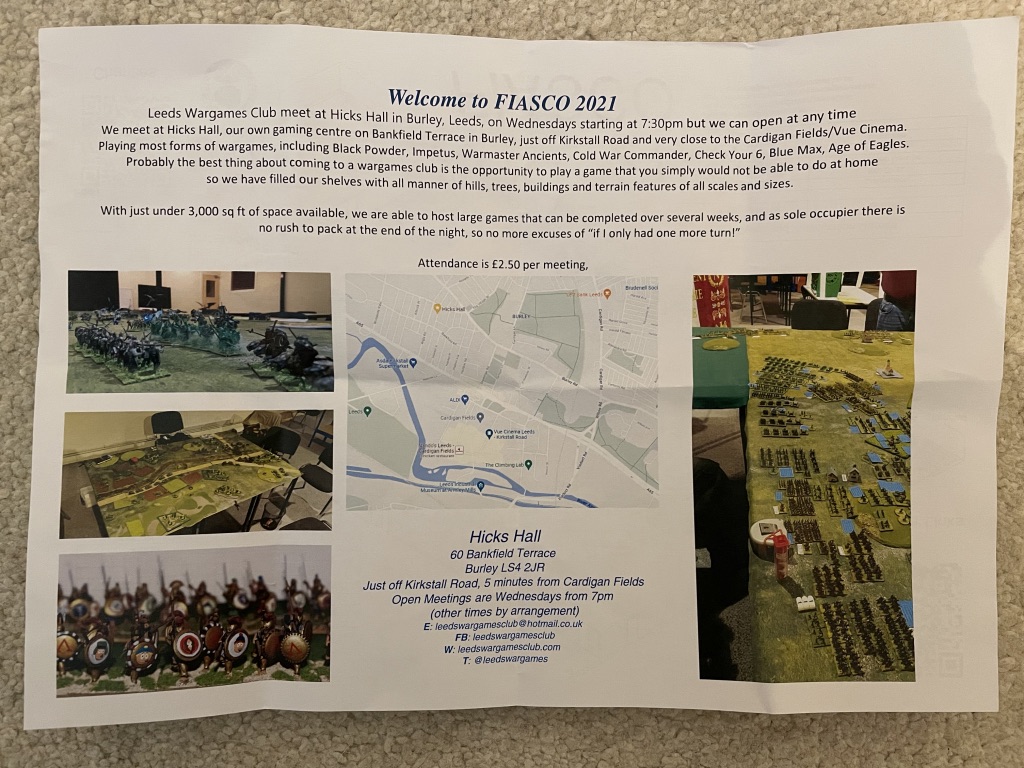
After almost 2 years absence, wargame shows once again became a reality and I was pleased to have visited Leeds Wargames Club’s show at the Royal Armouries in Leeds.

Fiasco sponsors Sue Ryder Charity and the Soldiers Charity – the Army’s National Charity as well as Models for Heroes and the Battlefields Trust.

Hicks Hall was again the venue with a reduced trader and gaming footprint which made circulation easier.
I felt people had come to buy, people came with a purpose – to trade. And to meet fellow gamers, talk, discuss, game and well – enjoy themselves!
This is the first show I have attended since Recon 2019 almost 2 years ago.
Mask wearing was evident as was no mask wearing, but numbers were down so crowding and congestion were not an issue.
Notable for me, were two games right at the entrance, The Battle of Stoke Field 1487 and The Italian Wars.
The Italian Wars was a great spectacle with colourful 15/16th century pike, arquebusiers and mailed knights not to mention artillery, bills, swordsmen and many flags by Petes Flags.
Bradford Battletech Battalion caught my eye as their hex game with these recent (2019ish!) kickstarter plastics robot warriors looked quite enticing even for someone like me, that normally struggles for gaming interest after Napoleon has hit the buffers. I say normally because today most of my purchases were World War Two themed!

A recent Yarkshire Gamers podcast about the Italian Wars.
And the Winner is…….
I did not get the name of the demonstrator at Breese and Hudson but I am guessing he was either Mr Breese or Mr Hudson of Mansfield or more specifically Radcliffe on Trent. He was lucid and measured in explaining Stoke Field, while being clearly very enthusiastic and showing his enduring interest in the battle. In fact absolutely everything you could wish for from a demonstrator when just strolling up to a demo game that catches your eye.
The rules they played to were never mind the billhooks expanded, and yes I forget to get a photo, but given it was 1487 you can guess the Wars of the Roses picture or rather can you?
Stoke Field is an outlier battle of the wars with King Henry VII already in power. The battle itself involves significantly, Irish soldiers as well as European mercenaries – notably pike. Like many interesting campaigns this battle ended quickly but that is no barrier to the gamer. Makes a change from Barnet, Tewkesbury and Towton.
So Stoke Field and Messrs Breese and Hudson win my vote as top show stand!

In my next post I consider my purchases……


Give now – https://justgiving.com/campaign/honresfield-library As a gamer with a love of toy soldiers and ImagiNations gaming, I have a lot of time …
Gamers, Readers – Help save the Brontes ImagiNations manuscripts for the nation and the Bronte Parsonage – donate to save the Honresfield Library …

One of my latest side projects is World War Two, like most projects I soon reach for the online supply chain. Lockdown has driven this approach even more.
And to start me off my first purchases were from Hannants and Models Hobbies. These companies have given me great value especially for projects where I buy all I need in one go.
But hang on I was/would be buying mainstream stuff, not obscure or discontinued lines. And this was to be a side track slow burn project. So bulk buys would not be the order of the day.
Then it occurred to me that I could go out of my way, with lockdown easing, to visit real hobby shops.
I also decided my interest would be more early war, ideally more inter war era. Just to make life difficult again, this is not the popular end of WW2. Yet this was a fantasy ww2 happening on Fauxterre so anything goes and flexibility is the watchword.
Ok so far, but hobby shops tend to stock the popular, as in, that’s loads of late war armour with a preponderance of German kit.
And then I had another brainwave. After going through online availability I realised I had a massive choice. I would just buy the cheapest stock available in dribs and drabs.
This random approach really started to appeal. It would also make this project different again.
Such an approach interestingly is increasingly not online (and certainly not ebay) + white van man, despite Amazons best endeavours. Don’t get me wrong, online has been fantastic for choice and it still offers great value and even ebay can give you amazing bargains (the effort required though has changed).
So I decided – cut out the postal costs. I would buy piecemeal and when other activities had paid for my journey.
Then if a shop turned up I would go in and see what was available.
This actually fed my Fauxterre ideas. The opponents are both struggling to resource their forces. The parallel for WW2 is the Russians. They took various kit from the USA, France and Britain before getting their own plants working to meet demand. And the Germans reused thousands of captured kit. Probably the most useful panzer they had early on was actually the Czech built 38T? The Russians also benefited from the US inventions of Christie that ultimately led them to the T34 as I understand it.
So a bit of history bashing and Fauxterre sees two protaganists poorly armed going to war with essentially inter war/early war kit and with inter war mentalities.
Next up was – which forces to use – given I had decided no german kit.
I chose the Russians simply because this whole sidetrack project was started by Charles Grant and his Battle Gaming book from 1977 – a charity shop surprise discovery.
Airfix came up often as the low cost option online and seeing as they had made Russians, the very ones in Charles Grant’s book, so that was it. Only they don’t make them any more and old sets are now online and vintage and with a price to match!
In the shops its allied west or german it seems.
After some wrangling I decided I would stick with the Russians and that led me to The Plastic Soldier Company and their good value sets. The Russians kit would be opposed by American kit with splashes of any other kit I liked, while playing that “buy cheap in a real shop” game.
I have made some progress and here are my first kit builds.

Lets see how I get on with this slow burn side track project.

James Fisher has a fascinating blog on Napoleonics. James asked me about Warrior Miniatures. Now I will say at this point Warrior Miniatures and I go back to the mid 1970’s, however my association has only ever been as a paying customer. So any effusive comments about them is simply reflecting my enthusiasm for their products.
So James wondered about plastics and the metals from Warrior Miniatures which I would add, shown here, are from their advertised 25mm range.
Now I have chosen to show the figures randomly arranged. Previously I have posted with some attempt to show exact height difference. Yet I think that ultimately it is the opinion that matters not the maths. So do they look ok?


Just for fun here are some other figure comparisons – I think hinds and caliver books still run these “retro” minifig/hinchliffe lines. I have posted elsewhere the gross sculpture change Greenwood & Ball did between their Garrison Normans and Vikings. I think the bigger more detailed Vikings shown here sunk without trace – while the older G&B figures were rerun for a time into the 2000’s?


Here is another oddity – again a short life production from Minifigs


Now I have dug out a later 25mm 1700 grenadier – I think its a foundry chap with practically no base.


Now some finished and based figures to compare against


To sum up, when it comes to height, I have become ever more tolerant and actually it is anatomy which jarrs my view. This is why I struggle with Perry figures – they are just so perfect. Which shows you just can’t please some people.

Finally a book which started my wargaming in earnest and is a celebration of fantasy gaming – I kid you not!

I leave you with this image from that book – published in 1967 – when it really probably was bad form not to have the correct facings or turnback colours etc. Lawford and Young said “play fantasy” and in the game photos they showed that scale was not a big issue. These look like 30mm figures rubbing shoulders with 45mm figures?????

Above all if it looks right to you then it is fine – play* away.
*tournament players will not be so lucky methinks.

Fauxterre 1930 looks a possibility.

Can you guess the manufacturers and vehicles modelled?
They are a work in progress but I don’t intend to be kind to them – they should look grubby and rough. And I am not happy about all this post Baroque malarkey………but thats the essence of erratic wargaming I guess.


A 1970’s 4VEP British Rail commuter train of slam door stock – what is going on?
A tenuous link I admit but I could not wrench it from my mind. I don’t think I have any older figures unpainted so this is my sort of painting record.


These figures are by Warrior Miniatures and are sold as french dragoons in their 25 mm napoleonic range. They are a slim 25mm and contrast with their then contemporary overfed minifigs from the 1970’s. I guess they were more like early hinchliffe before those got taller and bulked out somewhat.
I still love them after all these years so I am pleased they finally got a coat of paint!

I painted them as kleber dragoon’s and my inspiration is from the Funcken 18th century to modern times volume.

My intention is to use them in early campaigns of my Fauxterre Mythical Realm which covers 1815 to 1870 at present. It is all because of Fauxterre and Faux Napoleonics that they got painted anyway!
Thats another thank you to Renaissance Troll and his fantasy napoleonics post.
image license info – the train pic is used under

No sooner am I drifting from the mid 19th century by almost 100 years into world war 2, than I go the whole hog and leap several centuries – welcome to Bronze Age to Baroque does SciFi! – maybe.
I started the Wargaming Erratic blog in 2019 and aimed to cover my self declared restriction of “Bronze Age to Baroque”. In fact I had determined (for wargamer sanity reasons) to abandon not just my long time interests in world war 2 but also Napoleonics and the Seven Years War – anything after about 1730. The decision has proven to be easier to say than do.
It is not just bookshopping which can sidetrack your latest project (in my case Wars of the Italian Unification 1,2,3 – WOTIU). Strolling through other gamers blogs can be seriously distracting. Of course that is a very enjoyable activity with the vast range of ideas, activity and games being shown.
In this case “wargaming with barks” served up their new project using “five parsecs from home”. Now SciFi wargaming really has passed me by – even my D&D era, now eons gone, did not really depart from ancient medieval themes.
What caught me eye was that this ruleset is for solo wargaming – now that it is something that does fascinate me: Well wargames rules fascinate me anyway, solo rules especially so, because of the potential mechanisms on offer.
As Neil Thomas (author of one hour wargames) says, it is easy to write complex wargame rules while simple ones that constantly work are very challenging to compose.
In Five Parsecs from Home (FPfH) the movement and combat mechanisms themselves, look simple with the narrative derived from the wider aspects of character and weaponry for example.

So it is the case that two player wargames rules are more easily composed than solo rules when it comes to creating that unexpected and surprising element, which is at the heart of so much enjoyment in wargaming.
So far I have bought the book and had a quick speed read.
It looks very interesting and is a complete package including all your necessary rules plus both scenario and force generators.
Solo wargames much depend upon narrative to provide the variety and surprise in any game. It looks like this ruleset offers that potential in spades?
Finally solo wargames work just as well with live opponents – often just simply leaving out some rules is all it takes. So maybe you actually get two rulesets for the price of one!
 The Wargaming Erratic