What do you do when your sidetrack project becomes a Cuckoo in the nest. You buy another nest, metaphorically speaking, and stick it in it. I had attempted to paint and kitbash my way through the sidetrack project Fauxterre 1930, while progressing my main project of 2021 – Wars of Italian Unification 1848/1859 (in themselves ever more complicated but still fascinating).
So, having gone round the show in quick time I felt there was little to tempt me or solve my current project woes. “Or so I thought”.
Early War Miniatures was one of many (but not all) bigger traders busy selling at VAP22. With no bring and buy or competitions, plus only a select few demo/participation games, it was easy to get around but also the smaller sellers were not too diminished as they were spread across all 4 floors.
At Early War Miniatures I encountered a sell off of some completed figures. And they were exactly what I wanted for my Fauxterre 1930 project. Although I had opted for US and Russian forces – original plan – I had drifted into the interwar period and French forces had loomed into sight complete with Char B tanks, Renault’s and various quirky looking vehicles.
Net result was I came away with a prize and of course my wallet much lighter.
The effect was that a mini deluge in buying followed. There is a lesson in there somewhere.
The figures come next followed by the rest of my purchases with some kit armour and finished EWM tanks to finish.
French WW2 infantry from Early War Miniatures – 4 x 12 man rifle units plus HQ + Heavy Weapons The complete set of French WW2 figures – it was the fact that it was a useable set that caught my eye – all ready to go.
The rest of my buys were somewhat “erratic” of course……….
impulse buys at PendrakenMy Great Northern Wars “Era” project remains unrealised. I seem to find Italy ever more interesting across all periods.tufts for basing my italian wars of unification project (1848/1859) – for when I get some figures painted again!Pendraken again – small dice are simply too enticing – should be banned.I like AC’s!This Renault Truck I nearly bought in injection kit form from Hannants – but at a higher price!tankettes are the way forward!Some interesting armour and vehicles for Fauxterre 1930 From EWM, my slow build of a Russian WW2 force now includes some decals – very slow it would seemAs part of a show discount Early War Miniatures included these miscasts for free. They are intact enough to become part of the Fauxterre 1930 war effort.
So a big thank you to Early War Miniatures who fixed a growing problem. Pendraken as ever met my needs for all sorts of extras while HelionBooks invariably come up with attractive titles to feed my reading. Great Escape Games provided the tufts and some humour.
The large ground floor flowed freely as the demo and participation tables were absent this year.Plenty of the smaller traders were located on the higher levels
Last of all for those who stuck the journey………..
3 M11/39 Italian tanks from Early War Miniatures
Thats all folks – just maybe for patient “John the Varnish” the next post should be about Wars of the Italian Unification although Fauxterre 1930 is still squawking away!
Pursuing my side game of buying “face to face” for my latest project, in the world war two era, means wargames shows count.
For decades wargamers have treated shows as their own very necessary High Street. Remember once upon a time visiting “fairs” were very much part of medieval life for whole areas of a country. And of course prior to the internet and ebay they were the dominant route to wargaming purchases.
Quite simply the hobby could not sustain even general hobby shops on the high street even with railway and broader modellers sharing the same sources.
In fact talking about fairs reminds me that there is an excellent book by Graham Robb called the “Discovery of France” which highlights the circularity of life in France right up to the 20th century where whole rakes of the population derived their living through moving around the country. Even if your not a Francophile this book is a fascinating insight into a country which has dominated European Military history. His book certainly gives, in my view, a different view of France.
And then for the wargame shows, Covid19 really did drive us all fully online which may have far reaching consequences. On the evidence I saw at Leeds I am not sure what they will be though. Yes traders down, gamers down but then again we now have a late year crowded calendar plus organisers still having an obligation to manage their events to minimise the effects of Covid19 spread.
I for one, was a happy customer of the face to face variety.
I had stored up some planned purchases and spending money so here is a run down of my acquisitions and of course a “thank you” to the “SUPPLY CHAIN” without which we would not have the hobby we all enjoy.
First up some basics from Pendraken – 40×40 mdf bases for my currently stopped MAIN 2021 Project of the Italian Wars of Unification 1848/1859.
Colonel Bills yielded some 20mm preloved WW2 metals in the shape of a British Universal Carrier by SHQ and Romanian 47mm Schneider AT gun by FAA.
Regular visit to Coritani aka Magnetic Displays bought me some much needed paintbrush replacements and I spoilt myself with a prepainted crossroads – yes it was one of those days.
Stonewall Figures had some interesting kits and BT7 Russian Tanks were on my shopping list so these two Pegasus models dropped into my hand. And well these T34/76 armourfasts fell in as well.
Next up is a venerable book published in 1973 by Donald Featherstone. No4 in the series this is a bit late for me (1943-1945) as I am focused on early war activity. But it does cover the Tunisian Front and apart from Egypt/Libya where the British main north african action was, there is not so much printed material on matters west of Tunis.
Having grown up with Donald Featherstone books I find them an easy read: I know what I am getting. A nice purchase from Dave Lanchester.
Now for something completely different and I mean different. In this blog I have recounted my “sanity line” being nothing more recent than 1730-ish or the end of Peter the Greats reign. I caved in to Wars of the Italian Unification for 1848/1859/1866/1870 and suddenly found an interest in naval actions as well. You can see the slippery slope here………….Gradually ironclads have been creeping into my wargaming thoughts. So this book at Dave Lanchesters store was shown to me by Dave when I asked innocently if he had anything on Lissa 1866. Thanks to Dave I have a very nice 244 page hardback covering the second half of the 19th century.
Next up in contrast Grubbys Tanks yielded a small booklet at just 16 pages offering Rapid Fire fast play. This ruleset started life in 1994 so if age is pedigree that will do. I will give it a shot.
Now the Peter Dennis paper soldier books always look attractive and I finally picked up one I had previously nearly purchased back in 2018. The Spanish Armada is completely off my gaming list but I just could not resist, what with my current naval gazing.
I also tipped gaslands into the shopping basket at Dave Lanchester’s – not for me but as a christmas present for someone else.
The next two books from Dave were pure indulgence. The Russian Army in the Great Northern War 1700-1721 and William III’s Italian Ally 1683-1697 both Helion publications. I am hoping they will be ok on typos but I am not holding my breath. even so as I have posted before Helion publish where others fear to tread. So I have to be grateful.
Finally this is a repurchase – in fact I think it may be the third time I have bought this ruleset. Careless ……..
I do like Peter Pigs ideas, especially the uncertainty of process, and this set offers something a little different on the WW2 front.
Well thats it. Quite a mix when I think about it: More books than expected and less models.
So apart from Rapid Fire from Grubbys Tanks, I bought all my books at Dave Lanchester’s, who I must say keeps his books in very good condition.
The ones that got away or rather failed to appear – Russians by Plastic Soldier Company (Grubby’s were not short on Germans or US boxes though) and maybe a BA10 armoured car yet Stonewall Figures have promised to look out for one of them and set one aside for next year when they head north again.
So thanks to all my suppliers at Fiasco 2021 may you all prosper.
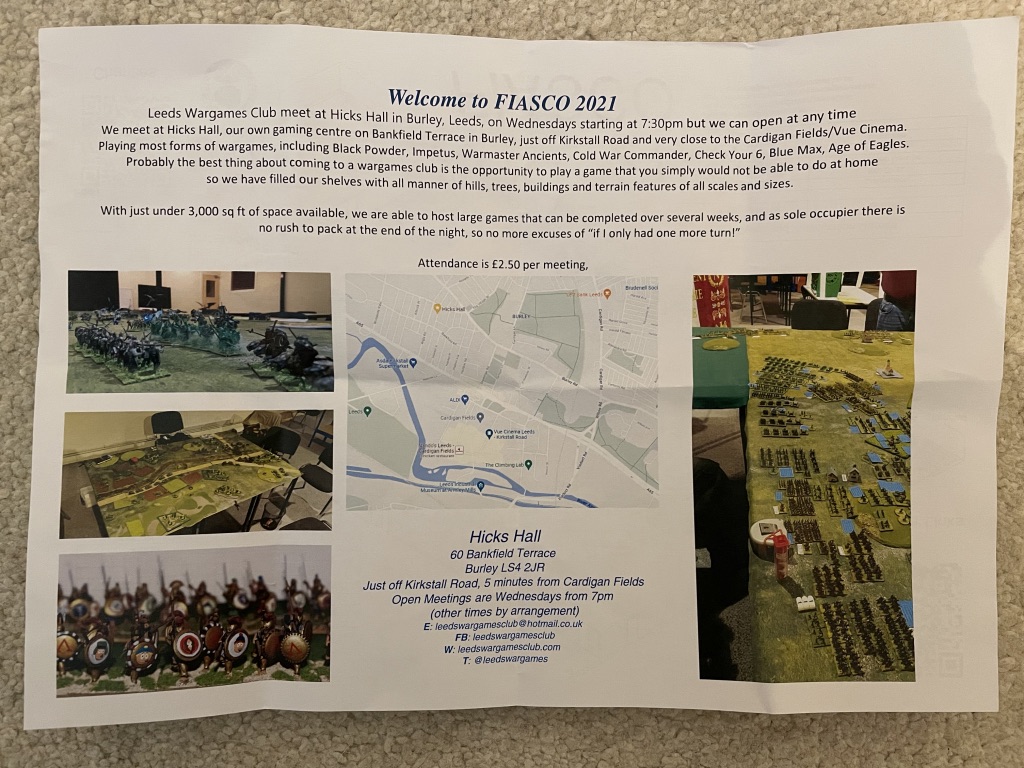
Thanks to Leeds Wargames Club for a very enjoyable show, all the sweeter, after such a long break from this aspect of wargaming.
Back to painting table………I wonder what will be up next?
Radeztky’s Marches is monumental. Written by Michael Embree the book is very detailed. It is monumental, in my view, because of the work done to knit sources together to provide at times a forensic description of Marshal Radetzky’s finest hours commanding the often derided Imperial troops of the Austro-Hungarian Empire.
Having read Michael Embree’s The Campaign in West and South Germany June-July 1866 first, I knew what to expect. That book ran to 260 pages of which 197 were text. Radetzky’s Marches has the same measured approach. Both books are driven by the detail. In that respect the conduct of the West/South German War story is almost a by product. It is the movement of units and their dispositions that count.
its not just what they were doing here, its who were they, names, unit numbers where they were from, who their officers were……
Similarly Radetzky’s Marches looks to what each unit was doing wherever possible. Perhaps there is more of the broader story in Radetzky’s Marches – it is certainly a broader war, with different theatres – although the focus is necessarily on Lombardy and Venetia.
Michael Embree explains the forces involved and gets across the naivety of the Various Italian forces and their leaders, as well as their optimism and ultimately despondency. The Austrians appear invariably stoic in the face of attack on all fronts.
Michael Embree takes no sides though, showing that Italians fought as much for imperial continuity as nation creation. It would take another 21 years for Italy to become recognisably the Italy we know today. In that time the French would evict Garibaldi from Rome, then occupy it, while in 1859 help Piedmont finally win Lombardy, before withdrawing from the future Italian capital in 1870 when going to war with Prussia. Ironic then that Garibaldi later fought at Dijon for the French against the Prussians.
Some excellent companion piece booklets which you can still find secondhand
The book runs to 470 pages of which 359 are the main part, so you get plenty of appendices and indexes – very useful and comprehensive.
Bibliographies of both books are extensive and multilingual. These show the author has considered many aspects of the conflict in arriving at the content finally presented.
I found the occurrence of the maps, their choice and purpose, at times a bit puzzling: There are sufficient maps so no complaints there. The selected illustrations I did enjoy and found they sat well with the text.
The book is full of minutiae concerning units and individual actions – detailing numbers, losses, names, moves and locations as each campaign step unwinds. You get lots of repetition, so at times it will feel like lists separated by some short text on the wider conflict or preparation for the next battle.
The book starts in 1848 with a preamble to war and then the retreat from Milan to the Quadrilateral. Here the Austrians would either lose Upper Italy or retain it. The four cities bounding the Quadrilateral were the key to the Po Valley and all Northern Italy. The book ends with the recovery of Venice in 1849.
So it is not a typical history book perhaps even in a military campaign sense. It is overburdened with the detail rather than the action. That is what makes it such a delight: When the action does occur it is all the more important. The chronology is there but it is not of primary concern.
Towards the end it feels like there are more “typos”. I tend to be quite forgiving on this matter. I think Helion are well noted for producing and filling unloved gaps in history writing as well as sometimes failing to deliver top quality editing. That is unfortunate given their support for such rare publications. Here it does not do any damage to the enjoyment. At least it meant I was still paying attention to the detail!
If your interests are the Italian Wars of Independence and especially the military activities of 1848/49 then this book is a must.
I can also recommend Michael’s book on the War in West and South Germany. I suspect it would be required reading if your interests are of the Franco-Prussian variety.




 The Wargaming Erratic